What Is Term Life Insurance? UK Guide & Quotes (2026)


Contents
Term life insurance covers a person for a fixed period. If that person dies while the policy is in force, the insurer pays the agreed benefit to whoever is legally entitled to receive it. Many UK policies can also pay early if the person covered is diagnosed with a terminal illness that meets the policy definition.
If the person is still alive when the term ends, the cover stops and there is normally no payout or refund. Term life insurance is protection, not a savings or investment product, so it does not build a cash-in value.
Contents
- Term life insurance at a glance
- How does term life insurance work?
- When does term life insurance pay out?
- Types of term life insurance
- Who may need term life insurance?
- How much cover and how long a term?
- How to get a term life insurance quote online
- Term life insurance underwriting
- Common exclusions
- Term life versus whole-of-life insurance
- UK term life insurance providers
- Writing a policy in trust
- How Eleos term life insurance works
Term life insurance at a glance
| Question | Short answer |
|---|---|
| How long does it last? | A fixed number of years chosen when the policy starts. |
| When does it pay? | Usually on death during the term; many policies also include a defined terminal illness benefit. |
| How is it paid? | Most commonly as a lump sum, although family income benefit pays regular instalments. |
| Does it build savings? | No. Standard term cover has no cash-in or surrender value. |
| What happens at the end? | Cover ends with no payout if there has been no valid claim. |
| What affects the price? | Factors commonly include age, health, smoking or nicotine use, lifestyle, occupation, cover amount and term. |
| Who might need it? | People whose death would leave someone else with a financial shortfall. |
Ready to look at a price? Get an instant online term life insurance quote with Eleos using the cover amount and term that fit the financial need you want to protect.
How does term life insurance work?
You choose a cover amount, sometimes called the sum assured, and a term. In return for paying the premiums, the insurer agrees to pay the policy benefit if a covered event happens before the policy ends.
For example, someone could take £250,000 of level cover for 20 years. If they die while the policy is active and the claim is valid, the full £250,000 is payable. If they outlive the 20 years, the policy ends without a maturity payment.
Who receives the money depends on how the policy is set up. It may be paid to trustees, an assignee, a surviving policyholder on some joint policies, or the estate. A trust can be used to specify who should benefit and may keep the payout outside the estate, but this is a legal and tax decision rather than an automatic feature of term insurance.
Term cover is different from critical illness cover and income protection. Critical illness cover pays only for conditions and procedures defined in that policy. Income protection pays an income when illness or injury prevents the insured person from working. A terminal illness benefit under a life policy is narrower: it normally requires a medical prognosis that meets the insurer's exact definition.
When does term life insurance pay out?
Death during the policy term
The central insured event is the death of the person covered while the policy is in force. The policy must have started, must not have expired or been cancelled, and required premiums must have been paid. The claimant will usually need to provide a claim form, a death certificate and evidence that they are entitled to the money. Depending on the circumstances, the insurer may also request medical, coroner or police records.
Life insurance is not limited to accidental death. Subject to the contract, it covers death from illness as well as accidents. The important limits are the exclusions and any special terms shown in the policy schedule or endorsements.
Terminal illness during the policy term
Many UK term policies include terminal illness benefit. A common definition requires a definite diagnosis of an incurable illness which, in the opinion of the relevant medical specialist or the insurer's medical officer, is expected to lead to death within 12 months.
This is an advance payment of the life benefit, not an additional second payout. Once the full benefit has been paid, the life cover normally ends. Definitions vary, so a serious or life-limiting diagnosis does not automatically qualify if it does not meet the policy wording.
What happens if the term expires first?
There is no payout simply because the term finishes. If cover is still needed, the person may have to apply for a new policy using their age and health at that time. Some products offer renewal or conversion options, but these are product-specific and should not be assumed.
What types of term life insurance are available in the UK?
The main difference between term policies is what happens to the amount of cover over time. The right structure depends on the financial need the policy is intended to meet.
Level term life insurance
With level term cover, the payout stays the same throughout the policy. A £250,000 policy still offers £250,000 near the end of the term, assuming no earlier claim or policy change.
Level cover can suit a need that does not reduce predictably, such as replacing income for a family, supporting children, covering an interest-only mortgage or leaving a fixed legacy. The trade-off is that inflation can reduce what a fixed sum will buy over a long term.
Premiums are often guaranteed and level too, but the cover amount and the premium are separate features. Check the schedule rather than assuming both are fixed.
Decreasing term life insurance
With decreasing term cover, the potential payout falls over the policy term. It is commonly used with a capital-and-interest repayment mortgage because both the cover and the mortgage balance are intended to reduce.
The policy is not normally linked to the lender's live balance. Instead, it reduces according to a formula and an assumed interest rate. A Royal London consumer summary for one specific Life Cover product, for example, describes cover designed around a repayment mortgage at a fixed 7% rate. Current Aviva guidance does not state a single rate; it warns that policies often have an interest-rate cap and may not clear the debt if the mortgage rate rises above it. Buyers should check the formula in the actual policy and whether the projected payout will remain sufficient if their loan changes.
Decreasing cover is not usually a natural match for an interest-only mortgage, because the capital balance does not steadily fall. It also leaves less money for other family needs as the term progresses. It will generally cost less than comparable level cover, but premiums normally remain fixed even as the benefit reduces.
Increasing term life insurance
With increasing or index-linked term cover, the benefit can rise over time to help offset inflation. The policy may use CPI, RPI or another stated measure. Premiums also rise, often by a different or higher percentage than the cover. See the separate guide to increasing term life insurance for a fuller explanation.
Aviva's current indexation guide describes cover rising in line with inflation without presenting one current index as universal. Legal & General's current adviser page is more specific: its increasing cover uses RPI, with annual cover increases capped at 10%, while premiums increase by RPI multiplied by 1.5 and are capped at 15%. The important point is not the label but the product formula: check the index, caps, premium increase and what happens if an annual increase is declined.
Family income benefit
Family income benefit pays regular instalments after a valid claim until the end of the chosen term, rather than paying one large lump sum. It can be useful where the aim is to replace monthly household income.
The total potential value falls as the term runs down. If a 20-year policy pays £2,000 a month after a claim in year two, far more payments remain than after a claim in year 18. A Royal London consumer summary for a specific Life Cover product lists family income benefit alongside level and decreasing cover and describes fixed monthly payments continuing from an accepted claim to the policy end. This should not be read as a feature of every current Royal London product.
Not every provider offers every type. In particular, Eleos's online term life product currently offers level cover only.
Who may need term life insurance?
The practical test is not whether someone owns a home. It is whether their death during a particular period would leave another person with costs, debts or lost support they could not comfortably meet.
Term cover may be relevant for:
- Parents and guardians. Life insurance for parents can help replace earnings, fund childcare and support children until they become financially independent. A stay-at-home parent can also have a substantial financial value because paid care and household work would be costly to replace.
- Couples who share finances. A surviving partner may need help with rent, bills, a mortgage or other joint commitments.
- Homeowners with a mortgage. Life insurance for homeowners can help protect the household from an outstanding mortgage. Level cover can match an interest-only balance; decreasing cover may suit a repayment mortgage if its reduction basis is appropriate.
- Renters with dependants. Life insurance can support ongoing rent and living costs. A mortgage is not a requirement.
- People supporting relatives. This can include adult children supporting parents, carers and people contributing to a family member's long-term care.
- Business owners or key people. Business protection can help with loans, ownership changes or the financial effect of losing a key person. This usually needs specialist structuring.
Someone with no dependants, shared debts or other financial obligations may have less need for life cover. Before buying, also check existing employer death-in-service benefits, workplace pensions, savings and current policies. Employer cover can be valuable but may end when employment changes.
How much cover and how long a term might you need?
There is no single correct amount. A useful starting point is to list the financial gap that would be created by the death of the person covered:
- mortgage and other debts that should be cleared;
- ongoing household spending and the number of years support may be needed;
- the value of unpaid childcare or caring work;
- future costs such as education; and
- existing savings, investments, employer benefits and life policies.
The term can then be matched to the longest time-limited need, for example, the remaining mortgage term or the years until the youngest child is expected to become independent. Allow for inflation when comparing a fixed lump sum over several decades.
Price is individual. UK insurers commonly assess age, medical history, height and weight, smoking or nicotine use, alcohol use, occupation, travel or residency and hazardous activities, as well as the amount and length of cover. Legal & General's underwriting explanation sets out these factors and explains that a medical examination is not required for every applicant. The separate life insurance without a medical guide explains when UK insurers may ask for additional evidence.
How to get a term life insurance quote online
A quote is an initial price based on the information entered. It is not necessarily the insurer's final offer: the price or terms can change after the full application has been underwritten.
Before requesting a quote, decide on the cover amount, term and cover type you want to price. Check:
- the amount payable at the beginning and end of the term;
- whether premiums are guaranteed, reviewable or index-linked;
- whether terminal illness benefit is included and how it is defined;
- single-life versus joint-life cover;
- exclusions, endorsements and policy-change options;
- who the insurer is and which compensation arrangements apply; and
- the support available during application and at claim.
The monthly premium only makes sense in the context of the protection offered. Read the final policy documents and make sure the cover meets the intended financial need before replacing any existing policy.
Before accepting a quote, also check:
- The financial need. What shortfall should the cover meet, and for how many years?
- The payout pattern. Should the benefit stay level, decrease with a debt, rise with inflation or arrive as a regular income?
- The claim definitions. Read the terminal illness wording and any survival or timing conditions.
- Who receives the money. Decide whether ownership, assignment or a trust needs consideration.
- Flexibility. Look for life-event increases, renewal, conversion, separation or policy-change options if these matter.
- The firm and insurer. Confirm who advises or administers the policy, who underwrites it, which regulator applies and what compensation protection is available.
Get an instant online term life insurance quote with Eleos. You can adjust the available cover amount and term during the quote journey before deciding whether to apply.
How does term life insurance underwriting work?
Underwriting is the insurer's assessment of whether it can offer cover, on what terms and at what price.
1. The application
The applicant answers questions about health and lifestyle. These may cover current and previous medical conditions, treatment, medication, family history, height and weight, smoking or nicotine, alcohol, occupation, travel and hazardous hobbies. The questions should be answered completely and accurately, including changes that occur before cover begins if the insurer asks for them.
2. Automated or manual assessment
Some straightforward applications receive an immediate decision. Others are reviewed by an underwriter. Possible outcomes include acceptance at the quoted price, acceptance at a higher premium, an exclusion or other special term, postponement while more information is gathered, or a decline.
A health condition does not automatically mean an application will be declined. The insurer looks at the diagnosis, severity, control, treatment, complications and other risk factors.
3. Additional medical or financial evidence
An insurer may request a report from the applicant's GP, a nurse screening, blood or urine tests, or a doctor's examination. This can be triggered by the application answers, age or the amount of cover. Many applicants are not asked to attend an examination.
The insurer needs the applicant's consent before requesting a GP report. Legal & General's medical-records guide also explains the applicant's right to ask to see the report before it is sent. For high sums assured, the insurer may request financial evidence to confirm that the amount has a reasonable relationship to income, assets, debts or the purpose of the cover. The guide to high-value life insurance looks at this additional financial and medical evidence in more detail.
4. The offer and policy documents
The final offer may differ from the initial quote. Read the policy schedule, statement of facts, policy wording and any endorsement before accepting. The statement of facts should accurately record the answers given. A wrong or incomplete answer can affect a later claim even if it was not intended to mislead.
Common term life insurance exclusions and reasons a claim may not be paid
Life insurance exclusions are usually shorter than those for health or income-protection policies, but that does not mean every death automatically produces a payout. Terms vary by insurer and policy.
Suicide during an initial exclusion period
A common exclusion applies if the insured person dies by suicide during the first 12 months of cover. Legal & General's current terms refer to suicide or intentional and serious self-injury in the first year. The Eleos Term Life policy wording also excludes suicide within 12 months of commencement. The exact definition and treatment of premiums are policy-specific.
Inaccurate or incomplete application information
If information was deliberately or recklessly false or misleading, an insurer may treat the policy as if it never existed and refuse the claim. A careless error can lead to a proportionate reduction, different terms or cancellation, depending on what the insurer would have done with the correct information. This is why disclosure should follow the exact questions asked rather than an applicant's own view of what matters.
Unpaid premiums or cover that has ended
A claim normally requires the covered event to happen while the policy is active. Missing premiums can cause cover to lapse after any grace and notice periods. Death after cancellation or expiry is not covered simply because premiums were paid in earlier years.
A terminal illness that does not meet the definition
Terminal illness benefit is not the same as cover for every serious illness. If the diagnosis is treatable, is not considered incurable, or the expected survival is longer than the period stated in the contract, the early-payment definition may not be met. The death cover can nevertheless remain in force, subject to the policy terms.
Policy-specific exclusions or endorsements
Underwriting may add a specific exclusion or restriction, and sanctions law can prevent an insurer from providing cover or making a payment in some circumstances. Always check the schedule and any endorsement. Do not assume an exclusion used by one provider appears in every UK policy.
Term life insurance versus whole-of-life insurance
Term and whole-of-life insurance can both pay on death, but they solve different problems.
| Feature | Term life insurance | Whole-of-life insurance |
|---|---|---|
| Duration | A fixed term with a stated end date | Intended to continue for life if policy terms and premiums are maintained |
| Payout | Only if a covered event happens during the term | Designed to pay on death whenever it occurs, subject to the contract |
| Cash value | Standard protection-only term cover has none | Depends on the product; do not assume every whole-of-life policy has one |
| Typical use | Mortgage, family or income needs that last for a defined period | Lifelong protection, funeral provision or some estate-planning needs |
| Relative cost | Often lower because a claim may never occur | Commonly higher because cover is intended to last for life |
Whole-of-life cover is not automatically better because it lasts longer. The appropriate comparison is the need, the period it lasts and whether the premiums remain affordable. Product definitions and cash values vary, so read the actual contract.
Term life insurance providers in the UK
The UK market includes large composite insurers, mutual insurers, adviser-distributed products and digital journeys. The table is a market snapshot, not a ranking or recommendation.
| Provider | Examples of term cover shown in current provider material | Route or feature to note |
|---|---|---|
| Aviva | Level and decreasing; increasing cover is described in its indexation guidance | Current consumer guidance explains level and decreasing cover without relying on the older policy PDF. |
| Legal & General | Level, decreasing and increasing | Offers direct life products and adviser-distributed protection; product terms differ. |
| Royal London | Current advised material describes level, decreasing and increasing options | A separate consumer summary for a specific product includes family income benefit; availability should be checked for the product being considered. |
| Scottish Widows | Level, decreasing and increasing, depending on product | Its Plan & Protect and Scottish Widows Protect products have different limits and options. |
| Vitality | Level, decreasing and increasing | Its proposition combines protection with an optional health and rewards programme. |
Review the actual contract rather than relying on brand recognition alone. Relevant points include the cover type, guaranteed or reviewable premiums, terminal illness definition, maximum term and expiry age, joint versus single cover, trust options, exclusions, increase options, support services and the application and claims process.
Should a term life policy be written in trust?
A trust can allow the policy benefit to be paid to trustees for the chosen beneficiaries rather than to the deceased's estate. This can speed up payment because the trustees may not need to wait for probate, and in many cases the proceeds do not form part of the estate for Inheritance Tax.
Those are potential advantages, not a promise that a trust is right in every case. HMRC's current life-policy guidance states that where the deceased was both the life assured and policyholder, the proceeds form part of their estate. GOV.UK's Inheritance Tax guide explains that IHT is a tax on the estate and that thresholds, exemptions and reliefs apply. A trust changes ownership and control, can be difficult to reverse and must be completed correctly. Consider legal or financial advice for personal circumstances.
How Eleos can help
If you already have an idea of how much cover you need and how long you need it for, Eleos offers a quick online route from quote to application.
With Eleos, you can:
- Get an instant online quote. Choose a cover amount and term to see the monthly price available through the digital journey.
- Shape the cover around your budget. Adjust the amount and term before deciding whether to apply.
- Apply online. Answer the health and lifestyle questions and submit the application digitally. Further underwriting may still be required depending on your answers.
- Ask for human support when you need it. Eleos advisers are available if you would rather talk through your needs, have questions about the application or want help understanding the options available.
The online product provides single-life, level term cover for UK residents aged 18–59 when the policy starts. Terms of 5–20 years are available, with cover ending no later than the policy anniversary after the insured person's 69th birthday. The monthly premium and cover amount remain fixed during the term.
It pays one lump sum if the insured person dies during the term or is diagnosed with a qualifying terminal illness. There is no cash-in value and no payout simply because the policy reaches its end date. The main stated exclusion is suicide within the first 12 months. Full definitions, exclusions and conditions are set out in the policy documents provided during the application journey.
Eleos is digital by default, but it is not online only. If the level term product available through the quote journey does not fit your needs, an Eleos adviser can discuss alternatives such as a higher cover amount, a longer term, decreasing or joint cover, or whole-of-life insurance. You can also ask for support before or during your application rather than having to work everything out alone.
Get an instant online term life insurance quote with Eleos and adjust the available cover and term to see what fits your budget.
What Is Term Life Insurance? UK Guide & Quotes (2026)
Frequently asked questions
Fact-checked and reviewed by Kiruba Shankar Eswaran or another licensed agent on our team. Read our editorial standards.
This guide is for general educational purposes and is not financial advice. Cover, eligibility and terms vary by insurer and by policy. Always read the policy documents for the full terms, limitations and exclusions before you buy.
Related resources
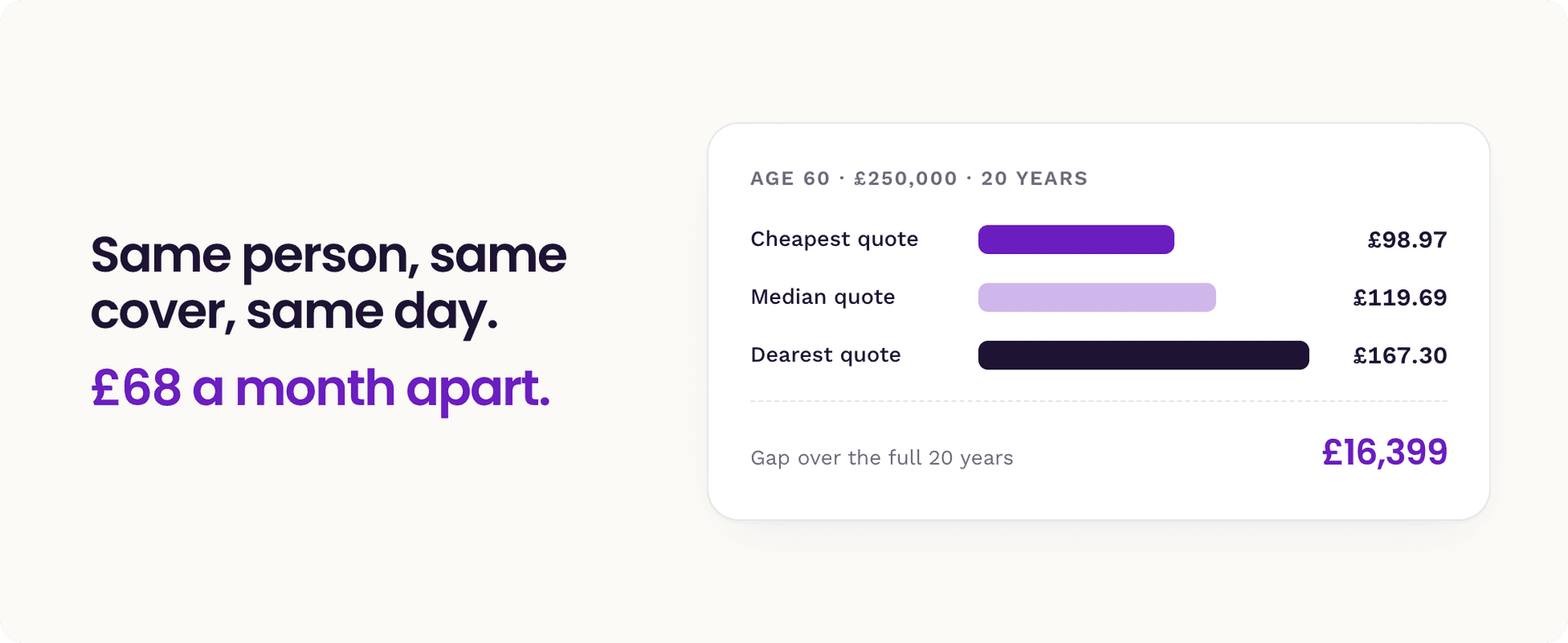
Life insurance cost UK 2026: what 6,557 real insurer quotes show
We collected 6,557 live quotes from UK life insurers in September 2026 and compared every one. Median prices by age, cover amount and policy length, how much smoking multiplies your premium, why bigger policies cost less per pound, and how mortgage protection compares with level cover.

6 Financial Resilience Tips for 2026
New Year, new money mindset. It’s time to break free from financial anxiety once and for all. Here are six simple tips to boost your financial resilience in 2026 and bring you peace of mind all year long!

Life Insurance for Young Adults
Life insurance for young adults doesn't have to be complicated or costly. This comprehensive guide covers why purchasing life insurance as a young adult locks in lower rates based on current health and how to pick the proper policy length and provider for your situation.

Turning Customer Curiosity Into Confidence: Theea's Coverage Calculator
Introducing Theea's Coverage Calculator: the intuitive insurance tool inspired by thousands of customer conversations that turns anxiety into tailored advice and confusion into confident choices.

Meet Your Newest Eleos Perks
We’re expanding our perks with two new additions designed to turn good intentions into healthy habits. Discover everything you can get for free with an Eleos policy.