Income protection insurance and redundancy


Contents
Redundancy insurance replaces part of your income if you lose your job through no choice of your own. In the six supplied wordings that include unemployment cover, the benefit is 65% of your gross monthly income, capped at £2,000, £2,500 or £3,000 a month. The unemployment benefit period is generally 12 months per claim.
There is one rule that matters more than all the others. You must buy it before there is any sign of trouble. Policies exclude a claim if you were aware of a risk of redundancy before the policy started, or during an initial exclusion period afterwards, even if the formal announcement comes later. By the time redundancy feels likely, it is generally too late.
One scope note matters: two supplied 12- and 24-month wordings describe accident and sickness cover and end when you become unemployed. They do not support the redundancy figures below, so the comparison uses the six supplied wordings that contain an unemployment section.
Contents
- What is redundancy insurance?
- Why it matters right now
- What does redundancy insurance pay?
- The two waiting periods
- The rule that catches most people out
- What is not covered
- Who can take out redundancy cover?
- Self-employed and fixed-term contract workers
- What you have to do to claim
- Redundancy or sickness: which risk is bigger?
- Is redundancy insurance worth it?
- How Eleos can help
What is redundancy insurance?
Redundancy insurance pays you a monthly amount if you are made involuntarily unemployed. It is short-term income protection, designed to cover essentials: mortgage or rent, bills and food while you find another job.
It is rarely sold on its own. Most policies bundle it as the "U" in ASU cover:
   A   Accident        you can't work because of an injury
   S   Sickness        you can't work because of illness
   U   Unemployment    you lose your job involuntarily
   +   Carer           you stop work to care for someone
You can usually choose which parts you want: unemployment cover on its own, sickness cover on its own, or a combination. Buying all of them costs more, but covers several ways an income can stop, including accident, sickness, unemployment and caring responsibilities.
It is not redundancy pay. Statutory redundancy pay is a legal entitlement from your employer based on age and length of service. Redundancy insurance is a separate product you buy in advance, and it pays on top.
Why it matters right now
The two risks this cover addresses are both real and measurable.
Unemployment. The UK unemployment rate was 4.9% in March to May 2026, with 1.76 million people unemployed, according to the Office for National Statistics. Payrolled employees fell by 90,000 over the year to May 2026.
Sickness. In 2025, an estimated 148.8 million working days were lost to sickness absence: around 4.4 days per worker, and 9.8 million days more than in 2019.
These are dated ONS estimates, and the labour-market figures are official statistics in development, so later releases may revise them.
   UK unemployment, March-May 2026

   Overall      ████████████████████  4.9%      1.76 million people
   Men          █████████████████████ 5.3%
   Women        ██████████████████    4.4%

   Source: ONS, Employment in the UK, July 2026
Source: ONS, Employment in the UK, July 2026
Neither number tells you what will happen to you. What they do tell you is that neither risk is exotic, and both are ordinary enough to plan for.
What does redundancy insurance pay?
Cover is built around a percentage of income with a monetary ceiling. Across the policy wordings reviewed for this guide, the percentage is consistent and the cap varies.
| Feature | Typical terms |
|---|---|
| Percentage of income | 65% of gross monthly income |
| Monthly cap | £2,000, £2,500 or £3,000 depending on the policy |
| Benefit period | 12 months per unemployment claim in the reviewed wordings |
| How it's paid | Monthly, in arrears |
| Lifetime limit | Some policies end after 60 monthly payments in total |
The benefit is the lower of the cap, 65% of your income, or the amount shown on your schedule. So the cap only bites above a certain salary:
   What 65% actually means

   £30,000 salary   →  £2,500/mth gross  →  65% = £1,625   ✓ under every cap
   £45,000 salary   →  £3,750/mth gross  →  65% = £2,437.50  ✓ under £2,500 and £3,000 caps
   £60,000 salary   →  £5,000/mth gross  →  65% = £3,250   ✗ capped at £2,000–£3,000
   £90,000 salary   →  £7,500/mth gross  →  65% = £4,875   ✗ capped: worth ~26-40% of income
The higher your salary, the less of it this replaces. On £30,000 the cap is irrelevant. On £90,000 a £3,000 cap replaces around 40% of gross income, and a £2,000 cap around 27%. That is not a reason to avoid the cover: it is a reason to know what you are actually buying.
Check your benefit still fits. Policies make it your responsibility to ensure the chosen monthly benefit does not exceed 65% of your gross monthly income. If your pay drops, an over-stated benefit does not pay out at the higher figure.
The two waiting periods
This is where most confusion lives, because there are two separate clocks and they do different things.
   Policy         Initial exclusion         Redundancy      Qualification      First
   starts         period                    happens         period             payment
     │                                          │                                │
     ├──────────────────────────────────────────┼────────────────────────────────┤
     │◄──── can't claim for unemployment ──────►│◄── wait before benefit ───────►│
     │       at all during this window          │      is payable                │
The initial exclusion period runs from the policy start date. You cannot make an unemployment claim during it at all. It exists to stop people buying cover once they can see redundancy coming.
The qualification period runs from the start of a claim. It is the number of days you must wait before any benefit becomes payable.
Both are set out in your policy schedule, not the policy wording, and they vary by product. Check your schedule for the figures that apply to you: this is the single most useful thing you can do with the paperwork.
Benefit is paid monthly in arrears, but the exact first-payment date depends on the option in your schedule. Some options backdate payment to the first day after the waiting period is completed; others pay only after the excess period. Budget for the gap shown in your schedule.
The rule that catches most people out
Read this section even if you skip the rest.
Policies exclude an unemployment claim if you knew, or could have known, that your job was at risk before cover began or during the initial exclusion period. The wording is deliberately broad. It can cover an employer announcement or action relating to redundancies, consultation, restructuring, merger, reorganisation, reduced hours or reduced salary in your department or division.
Three things follow.
It's not just formal notice. An announcement about your department is enough. A consultation. A restructure. A merger. You do not need to have received a letter.
Timing of the announcement beats timing of the redundancy. The exclusions apply if you are notified during the initial exclusion period "even if your last day in work falls outside this period", and if you were made aware of a risk during that period "even if the formal notification of your unemployment was issued outside this period".
Awareness before you bought usually excludes the claim. A separate exclusion applies if you were aware of the risk or possibility of becoming unemployed before the policy start date.
The practical rule. Redundancy insurance is bought when everything is fine. Once there is a rumour, a consultation or a restructure in your part of the business, the window has closed. This is not fine print being unfair: it is how the product remains affordable for everyone else.
What is not covered
The typical exclusions from a policy wording, in plain terms:
| Not covered | Meaning |
|---|---|
| You chose to leave | Resignation. Also voluntary redundancy, because you made the decision. |
| Misconduct | Dismissal for your own conduct. |
| Retirement | Permanently retiring is not unemployment. |
| Seasonal work | Work where unemployment is a normal, regular or seasonal occurrence. |
| Casual or temporary work | Work of a casual, temporary or occasional nature. |
| A contract simply ending | A fixed-term contract you knew at the start would expire on a known date. |
| Claiming too early | Any claim during the initial exclusion period. |
| You saw it coming | The awareness rules above. |
Voluntary redundancy is the one people misread. Taking a voluntary package is you deciding to leave. It generally does not qualify, however involuntary the circumstances felt.
Who can take out redundancy cover?
Eligibility varies between the six unemployment wordings, but the recurring requirements are:
- Entry from age 18, with an upper limit of 63 or under 64, depending on the wording
- Residence in the UK, or in the UK, Channel Islands and Isle of Man for some products
- Being in work, with some wordings requiring six continuous months before the policy starts
- No awareness of impending unemployment or a relevant risk before the policy starts
- If self-employed, no known reason that the business is likely to close
The six-month employment history is not universal, so check the wording and schedule for the product you are considering. Someone who has just started a new job may need to wait before some cover is available.
The age limits reflect short-term cover intended to bridge a return to work, not a guarantee that every applicant up to that age will be accepted.
Self-employed and fixed-term contract workers
Both may be eligible, but the terms are different enough to read carefully.
Self-employed. Unemployment is defined much more strictly. It generally means totally and permanently ceasing to trade because of a business failure, with HMRC notified accordingly. A quiet quarter, losing a major client, or pausing trading does not meet that definition. This is a business-failure benefit, not an income-fluctuation one.
Fixed-term contracts. A contract that ends on a date you already knew about is normally excluded. But some wordings include two important exceptions where cover can still apply:
   Fixed-term contract ends: is it covered?

   You knew the end date at the start           ✗  normally excluded
   ...unless extended by 12+ months after
      the policy start date                     ✓  can be covered

   You'd been with the same employer 12+
   consecutive months and the contract has
   been renewed at least once                   ✓  can be covered

   You were permanent with that employer and
   transferred to a fixed-term contract with
   no break in employment                       ✓  can be covered
If you are a long-standing contractor with a repeatedly renewed contract, you are in a materially better position than a first-time fixed-term worker. It is worth checking which description fits you before assuming you are uninsurable.
What you have to do to claim
Redundancy cover is conditional on genuinely looking for work, and the requirements are specific.
Be entirely without paid work. Taking temporary work can stop or suspend a claim, although some wordings allow benefit to resume when the temporary work ends. Tell the claims administrator before starting any work.
Be available for, and actively seeking, work for the whole duration of the claim.
Register with Jobcentre Plus where required. Several policies require registration with the Department for Work and Pensions Jobcentre Plus, or the Northern Ireland equivalent, within three months of the claim starting, with continued registration after that. Other wordings require ongoing proof that you are unemployed and actively seeking work.
Provide ongoing evidence. Benefit stops if you fail to provide proof that you remain unemployed.
Keep paying premiums. You must keep paying while receiving benefit. Missing a premium can end the policy, including mid-claim.
None of this is unusual, but it does mean redundancy cover is not passive. It is a monthly obligation during exactly the period you have most else to deal with.
Redundancy or sickness: which risk is bigger?
Most people buy this cover thinking about redundancy. But ASU can also cover loss of income caused by illness. The useful comparison is long-term sickness absence, not a few days off with a cold. ONS data suggests that risk deserves equal attention.
| Scale | |
|---|---|
| Unemployment | 4.9% of the workforce, 1.76 million people, March–May 2026 |
| Sickness absence, overall | 2.0% of working hours lost in 2025 |
| Sickness absence, long-term condition | 4.0% for workers with a long-term health condition, compared with 1.0% without |
The overall annual total was 148.8 million working days, or 4.4 days per worker. That includes short absences and is not a direct measure of a long-term claim. The more relevant comparison is the absence rate for workers with and without a long-term health condition:
   Long-term health condition  ████████████████████  4.0%
   No long-term condition      █████                 1.0%
   Overall                    ██████████            2.0%

   Source: ONS, Sickness absence in the UK labour market: 2025
Source: ONS, Sickness absence in the UK labour market: 2025
Two findings stand out for anyone weighing up cover.
Long-term conditions change the picture entirely. Employees with a long-term health condition recorded a 4.0% absence rate against 1.0% for those without: four times higher.
This is the risk the policy can address. The sickness part of ASU cover is intended for an absence that continues beyond the waiting period and meets the wording's medical evidence rules. It is not designed to pay for every short illness or a few days away from work.
If you only insure one of the two risks, base the choice on your own situation: job security, sector, health history: rather than on which feels more frightening.
Is redundancy insurance worth it?
It depends on three things you can actually assess.
How long could you last without income? If you have six months of expenses saved, the cover buys less than it would for someone with none. If a missed month means missing a mortgage payment, the case is much stronger.
What would 65% capped actually give you? On £30,000 it is most of your take-home. On £90,000 it is roughly a quarter to a third of gross pay. Both can be worth having, but they are different products in practice.
How exposed is your sector? Public sector absence ran at 2.9% against 1.7% in the private sector, and redundancy risk varies enormously by industry. You know your own sector better than any average does.
Where it works well: a mortgage or rent you must cover, limited savings, a single-income household, or a sector with visible restructuring risk: bought while everything is still stable.
Where it works less well: substantial savings, a generous employer redundancy scheme, a high salary where the cap replaces little, or work that is casual, seasonal or on a first fixed-term contract.
How Eleos can help
Redundancy cover is one of those products where the detail decides whether it pays.
Our advisers can talk you through income protection and unemployment cover, including the details that actually matter before you commit, not after a claim is declined.
- We'll explain the available parts. Accident, sickness, unemployment and carer cover may be available separately. Paying for more cover than you need can add unnecessary cost.
- We'll check the waiting periods on your schedule, because the initial exclusion and qualification periods are where expectations and reality separate.
- We'll be straight about the cap. If 65% of your income sits above the policy maximum, you should know that at the point of sale, not at the point of claim.
- We'll flag it if you're not eligible yet: a six-month employment requirement where it applies, or the awareness rules, rather than selling you cover that cannot pay.
- We can look across the market for cover better matched to your situation, including if you're self-employed or on a fixed-term contract.
Our UK advisers are available during working hours. The quickest way to reach us is a WhatsApp message, and someone will come back to you.
One thing worth acting on today: this cover has to be in place before there is any sign of trouble. If your employer has already announced a consultation or restructure affecting your part of the business, the window for that claim may have closed. If everything is fine, that is exactly when it is available.
Income protection insurance and redundancy
Frequently asked questions
Fact-checked and reviewed by Kiruba Shankar Eswaran or another licensed agent on our team. Read our editorial standards.
This guide is for general educational purposes and is not financial advice. Cover, eligibility and terms vary by insurer and by policy. Always read the policy documents for the full terms, limitations and exclusions before you buy.
Related resources
Life insurance cost UK 2026: what 6,557 real insurer quotes show
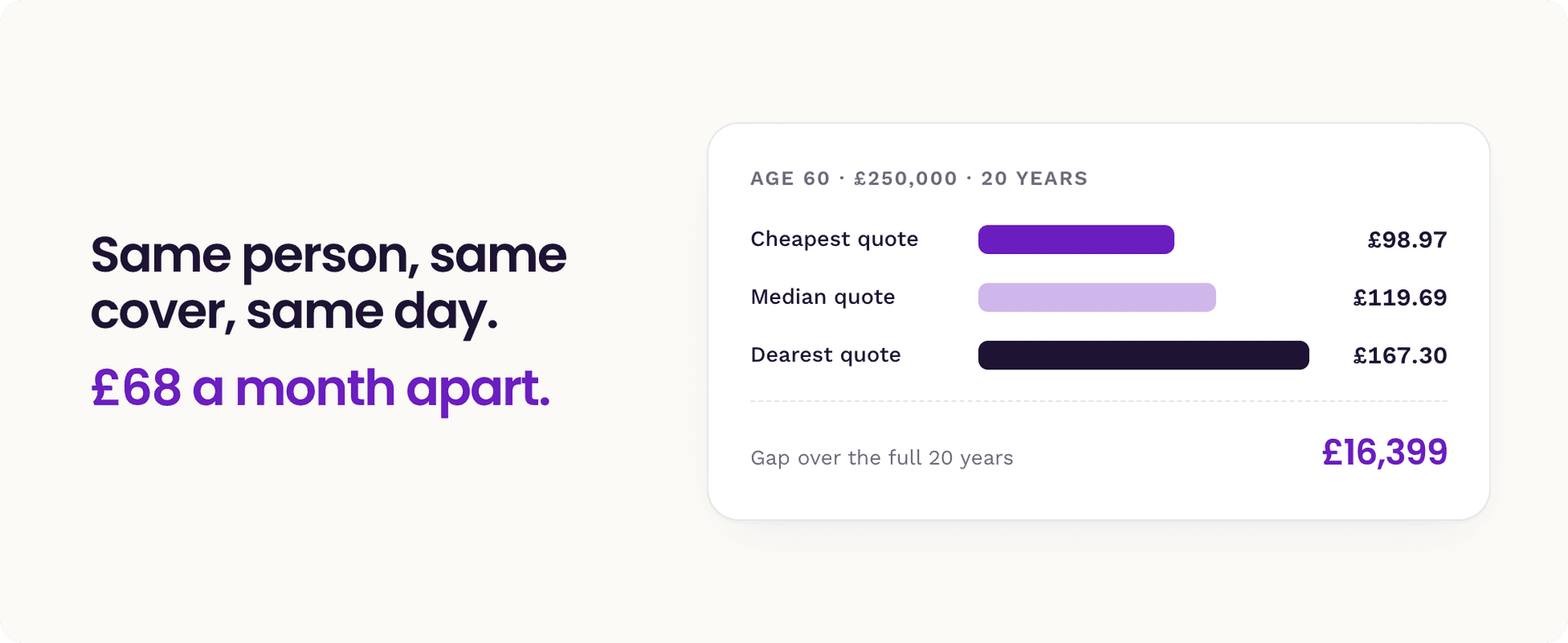
We collected 6,557 live quotes from UK life insurers in September 2026 and compared every one. Median prices by age, cover amount and policy length, how much smoking multiplies your premium, why bigger policies cost less per pound, and how mortgage protection compares with level cover.

What Is Term Life Insurance? UK Guide & Quotes (2026)
A complete UK guide to term life insurance: how it works, what it costs, the main policy types, underwriting, how it compares with whole of life, and the top UK providers.

6 Financial Resilience Tips for 2026
New Year, new money mindset. It’s time to break free from financial anxiety once and for all. Here are six simple tips to boost your financial resilience in 2026 and bring you peace of mind all year long!

Life Insurance for Young Adults
Life insurance for young adults doesn't have to be complicated or costly. This comprehensive guide covers why purchasing life insurance as a young adult locks in lower rates based on current health and how to pick the proper policy length and provider for your situation.

Turning Customer Curiosity Into Confidence: Theea's Coverage Calculator
Introducing Theea's Coverage Calculator: the intuitive insurance tool inspired by thousands of customer conversations that turns anxiety into tailored advice and confusion into confident choices.

Meet Your Newest Eleos Perks
We’re expanding our perks with two new additions designed to turn good intentions into healthy habits. Discover everything you can get for free with an Eleos policy.