Age-based premiums vs level premiums


Contents
From a simple idea, life insurance has evolved into a network of complementary and alternative options for financial protection. This can cause a lot of confusion when you’re trying to settle on the right one for your situation. It may be helpful to establish one of the fundamental distinctions between the different types.
Life insurance is a way of providing for your family and dependants after you’ve passed away. In most case, but not all, it’s a long-term plan to guarantee their financial security far into the future. But what does long-term mean?
Essentially, life insurance policies take two forms: whole life and term life. A whole life policy is open-ended, lasting until the death of the insured. A term life policy lasts for a fixed period (usually up to 30 or 40 years) and pays out if the insured dies within that period. When the policy reaches its expiry date the cover it provides ends.
Two very popular choices of life insurance are age-based and level variants. Age-based ones tend to be whole life policies, while level ones are more likely to be term life policies. However, they are not mutually exclusive and it’s possible to have whole life and term life insurance in either form.
Aged-based policies
An age-based policy is one in which the premiums increase, usually each year, as the insured gets older. Factors that will affect your life insurance premium include your age, your health, your family medical history and your occupation. The final payout – the sum assured – increases in step with the premiums.
Level policies
A level policy is one in which the premiums remain the same throughout the policy, irrespective of the age of the insured. The sum assured is set at the start of the policy and remains the same throughout.
The premiums for age-based policies usually start off relatively low because insurers assess the level of risk over many years and calculate the compound revenue they’ll receive in the long term. They can afford to offer a low starting rate because the initial level of cover is also quite low. As the sum assured grows, your insurer will increase your life insurance premiums by age.
What is the rate of increase?
Each insurer will make its own judgements on the appropriate size of the annual increase but as a rough guide, it’s fairly common for age-based premiums to increase by around 5% each year. The payout grows by a similar amount.
What are reviewable premiums?
An age-based premium can either be subject to a consistent percentage increase each year, or it can be reviewable. This means rather than just applying the automatic increase, the insurer can review the policy by looking not just at the age of the insured but also their state of health at the time of the review and other factors including the rate of inflation.
The main advantages of age-based premiums
Cost
Because age-based premiums usually start off lower than level premiums they are attractive to people who want to get their life insurance in place as soon as possible, but may have budgetary constraints in the early years.
Inflation
Because age-based premiums increase the sum assured, it’s possible for the eventual payout to keep up with inflation. The increase in the cost of living over several years means that a sum that’s fixed at the start of the policy could be worth significantly less in real terms after 20, 30 or 40 years.
Length of policy
You can take out a whole life policy with age-based premiums so that the final payout always increases. You can also choose a term life policy to give the same kind of increasing cover, but set to end at a time when you believe it will no longer be necessary.
Main disadvantages of age-based premiums
Cost
The downside of keeping costs low at the start is that they will rise each year. For example, if an initial premium of £25 a month were to increase by 5% annually then it would be over £60 a month within 20 years.
Uncertainty
Age-based premiums are designed not only to take account of how risk increases with age but also to make sure the insured has enough cover to make up for the erosion of value caused by inflation. However, it’s not an exact science because the forces that act to increase inflation can’t always be predicted. Spikes in the cost of living could mean the policy is under-performing. Also, if your premiums are reviewable, you may not always know how much of an increase to expect.
Level premiums are set permanently at the same level throughout the life of the policy. The eventual payout also stays the same. Both figures are calculated according to the age of the insured at the time they take out the policy as well as their health and any other risk factors. Insurers are also likely to consider the possible effects of increasing age and declining health over time but won’t adjust the premiums or the sum assured – these issues are built into their initial underwriting.
Main advantages of level premiums
Cost
Level premiums generally start at a higher level than age-based premiums but this is at least partially compensated for over time by the fact that they never increase. Depending on the length of the policy, it could work out cheaper over all.
Consistency
This allows for certainty when you’re budgeting. Unlike policies which calculate your life insurance cost by age, level premiums are an unchanging cost which makes it easier to plan years ahead.
Length of policy
As with age-based premiums, you can find insurers who will offer both whole life and term life policies with level premiums.
Main disadvantages of level premiums
Inflation
Fixing the payout at the start with level premiums means you have no protection against the effects of inflation. A figure you choose today won’t be worth the same in 30 years. The Bank of England has a useful calculator that demonstrates the potential of inflation to erode the value of money.
Higher future expenses
Just as level premiums don’t let you keep pace with inflation, they don’t anticipate the possibility that your dependants may face unforeseeably higher costs in the future, for things like university tuition fees and house prices.
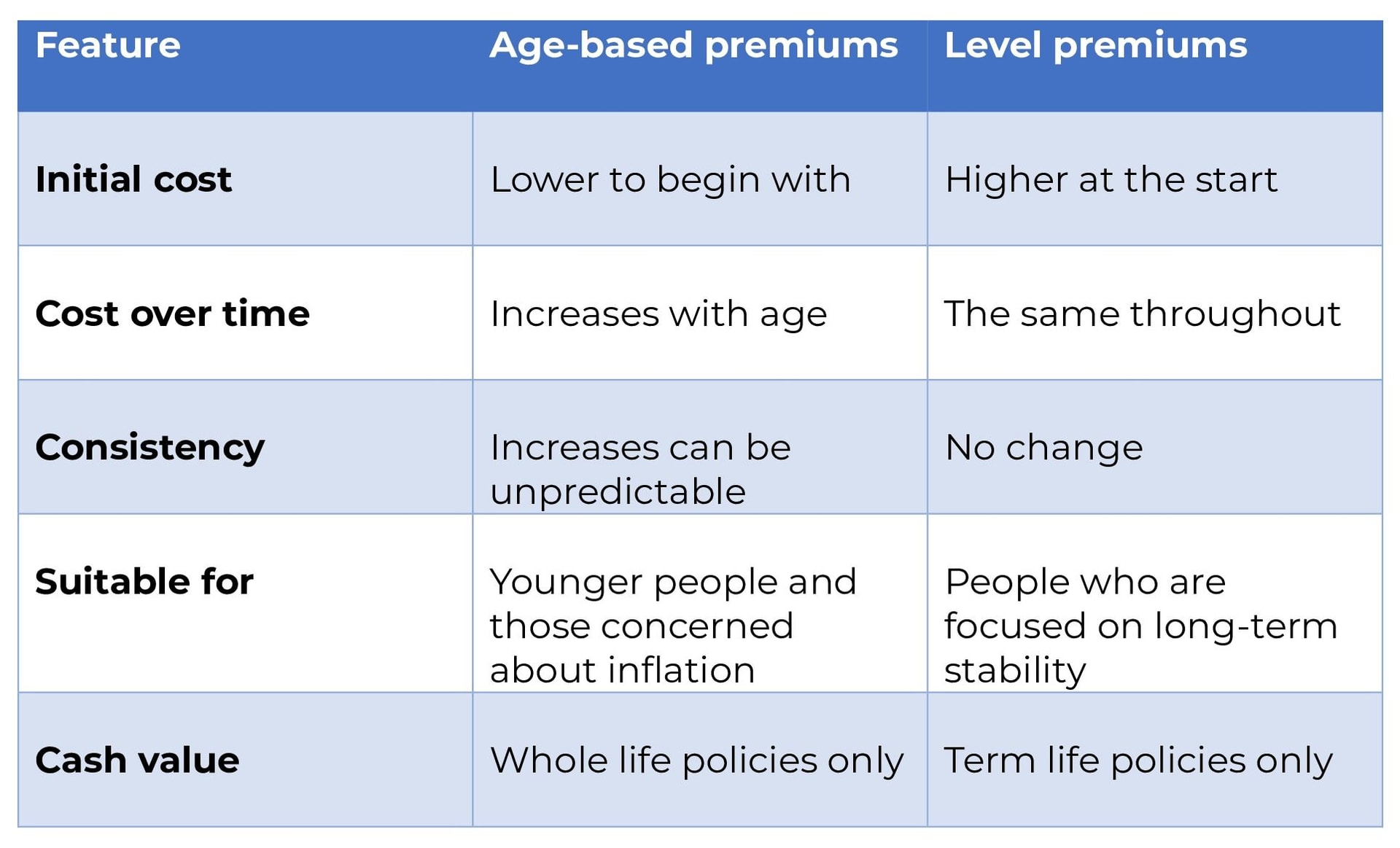
Ultimately only you can decide what will work best for you. Both have their pros and cons so you may not find either to be the ideal answer. However, if you take into account the widest range of considerations – including your current circumstances, your expected future earnings and the growing or shrinking needs of your family – you may be able to settle on an acceptable solution.
Who are age-based premiums for?
They’re particularly suitable for younger applicants who may prefer the initial lower cost but are prepared to pay higher premiums as they get older and their income increases.
Who are level premiums for?
These are often favoured by those who prefer predictability and stability in the cost of their protection, without being concerned about matching inflation.
Age-based premiums vs level premiums
Frequently asked questions
Fact-checked and reviewed by Kiruba Shankar Eswaran or another licensed agent on our team. Read our editorial standards.
This guide is for general educational purposes and is not financial advice. Cover, eligibility and terms vary by insurer and by policy. Always read the policy documents for the full terms, limitations and exclusions before you buy.
Related resources
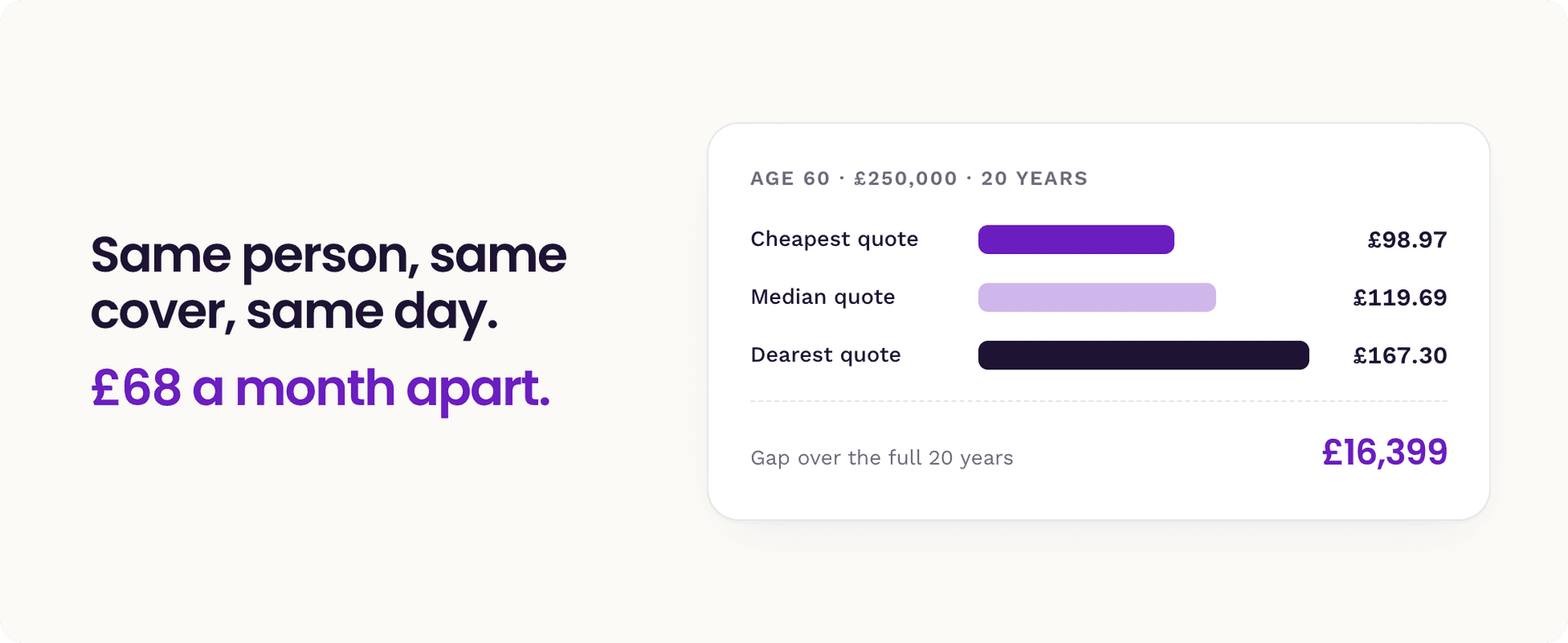
Life insurance cost UK 2026: what 6,557 real insurer quotes show
We collected 6,557 live quotes from UK life insurers in September 2026 and compared every one. Median prices by age, cover amount and policy length, how much smoking multiplies your premium, why bigger policies cost less per pound, and how mortgage protection compares with level cover.

What Is Term Life Insurance? UK Guide & Quotes (2026)
A complete UK guide to term life insurance: how it works, what it costs, the main policy types, underwriting, how it compares with whole of life, and the top UK providers.

6 Financial Resilience Tips for 2026
New Year, new money mindset. It’s time to break free from financial anxiety once and for all. Here are six simple tips to boost your financial resilience in 2026 and bring you peace of mind all year long!

Life Insurance for Young Adults
Life insurance for young adults doesn't have to be complicated or costly. This comprehensive guide covers why purchasing life insurance as a young adult locks in lower rates based on current health and how to pick the proper policy length and provider for your situation.

Turning Customer Curiosity Into Confidence: Theea's Coverage Calculator
Introducing Theea's Coverage Calculator: the intuitive insurance tool inspired by thousands of customer conversations that turns anxiety into tailored advice and confusion into confident choices.

Meet Your Newest Eleos Perks
We’re expanding our perks with two new additions designed to turn good intentions into healthy habits. Discover everything you can get for free with an Eleos policy.