Does Income Protection Cover Mental Health? A UK Guide for 2026


Contents
Last reviewed: August 2026. Underwriting positions are drawn from the 2025 and 2026 editions of five UK insurers' published adviser guides, listed in full at the end. Statistics are the latest available at the date of review.
Mental health used to be stigmatised. People experiencing it tended to keep it quiet, for all sorts of reasons: a sense of weakness or personal failure, embarrassment, a fear of being gossiped about. Raising mental health at work felt risky. How would employers and colleagues react? Would your job even be safe?
Attitudes have changed. There is far greater understanding today of what mental illness is, where it comes from, how it affects people and how it can be treated. Employers put real emphasis on the mental wellbeing of their staff, because they know it can affect anyone.
Income protection insurance provides financial support if illness or injury stops you working. So can you claim income protection for mental health?
Can you claim income protection for mental health?
Yes. Mental health conditions are covered by standard UK income protection policies in the same way as physical illness, and they are among the most common reasons people claim.
That is the short answer. The longer answer has two parts that matter a great deal, and most articles skip both:
- Claiming on a policy you already hold for a condition that developed afterwards is generally straightforward, subject to the policy's definition of incapacity and medical evidence.
- Getting cover in the first place, when you already have a mental health history, is a different question. Insurers underwrite it, and the terms you are offered vary enormously depending on severity and on which insurer you apply to.
This guide covers both.
What counts as a mental health condition?
NHS England reports that "one in four adults and one in 10 children experience mental illness". But mental illness appears in many forms, some clearly diagnosable and others harder to pin down. Here are the main categories.
Depression
People often casually describe themselves as depressed when they are feeling low, which is fair enough. Clinical depression is different. It involves feeling unhappy, but goes far deeper: low self-esteem, physical inertia, an inability to take pleasure in anything, feelings of profound hopelessness. At its most extreme it can lead to suicidal thoughts.
Depression can stem from life experiences or from internal chemical changes, and the cause can influence treatment, which includes medication and counselling. Whatever the reason, someone experiencing depression may find it impossible to work.
Stress
Most of us feel stressed sometimes. Some people thrive on it. But sometimes it becomes overwhelming and has a major effect on behaviour and the ability to cope with otherwise ordinary tasks. Symptoms can be physical, such as headaches, muscle and chest pain and dizziness, and mental, such as poor concentration, constant worry and a sense of being unable to cope. Most cases of severe stress are treated with talking therapies.
Anxiety
Anxiety disorders are characterised by fear and dread out of proportion to the situation. Panic attacks are common, with symptoms such as a racing heartbeat, breathing difficulties, nausea, sweating and trembling that can convince the person they are about to pass out or even die.
Burnout
Burnout describes the experience of people subjected to long-term workplace stress who now feel physically, mentally and emotionally exhausted.
One point worth understanding if you are thinking about a claim: burnout is classified as an occupational phenomenon rather than a medical condition. That does not mean an insurer will dismiss it, but a claim is assessed on your symptoms and their effect on your ability to work, and those are often recorded clinically as anxiety, depression or a stress-related disorder rather than as "burnout" itself.
Post-traumatic stress disorder (PTSD)
Originally identified in people on active military service and survivors of accidents and disasters, PTSD is now known to affect people who have experienced or witnessed frightening or distressing events. Symptoms include flashbacks, nightmares and severe anxiety.
Bipolar disorder
Known in the past as manic depression, bipolar disorder involves mood swings extreme enough to move from deep depression to manic and sometimes psychotic states.
Bipolar disorder is treated very differently from anxiety and depression at the application stage, which is covered below.
This is not an exhaustive list, but these are among the most frequently cited reasons for being unable to work.
How common are mental health income protection claims in the UK?
Very. The Association of British Insurers notes that mental health has been the most common cause of claim on UK income protection policies.
Individual insurers publish their own figures and they vary, but the scale is consistent. LV=, for example, has reported that mental health accounts for 29% of its income protection claims.
The wider picture supports it. Health and Safety Executive figures show 22.1 million working days lost to work-related stress, depression or anxiety in 2024/25, out of 35.7 million days lost to work-related ill health in total. Mental health accounts for well over half of all working days lost to work-related illness in Britain, and more than three times the days lost to musculoskeletal problems.
How do you qualify for a mental health income protection claim?
The definition of incapacity is what matters
Income protection insures your ability to earn rather than your health in the abstract. What triggers a claim is not the label attached to your condition but whether you meet the definition of incapacity written into your policy.
Most UK policies use one of three definitions, and the difference is significant.
| Definition | What it means | Why it matters for a mental health claim |
|---|---|---|
| Own occupation | You cannot perform your own job | Strongest. Recognises that you may be unable to do your role while being capable of some other work |
| Suited occupation | You cannot do your own job, or any other job suited to your experience, education or training | Weaker. An insurer can point to work you could do instead |
| Activities of daily work | You cannot perform a set number of defined tasks | Weakest for mental health, because the defined tasks are often physical |
For mental health this matters more than most people realise. Someone experiencing severe anxiety may be unable to do a client-facing role while remaining physically capable of other work, so an own occupation definition gives materially better protection.
What evidence insurers ask for
You will need medical evidence. Insurers typically want your GP's assessment, details of treatment and, for longer claims, ongoing evidence that you remain unable to work.
It is sometimes said that you do not need a diagnosis to claim for mental health. That overstates it. What is true is that assessment focuses on your symptoms and their functional effect on your ability to work rather than on the precise diagnostic label, which helps in a field where similar symptoms occur across different conditions. But you will still need clinical evidence supporting your inability to work, and a claim will not succeed on self-reported difficulty alone.

Illness isn't always physical
You can protect your income from the effects of mental illness too.
How do UK insurers underwrite a mental health history?
This is where the honest detail lives, and where the outcome depends heavily on which insurer you approach. The patterns below are drawn from underwriting guides published for financial advisers by Aviva, LV=, Royal London, The Exeter and Cirencester Friendly.
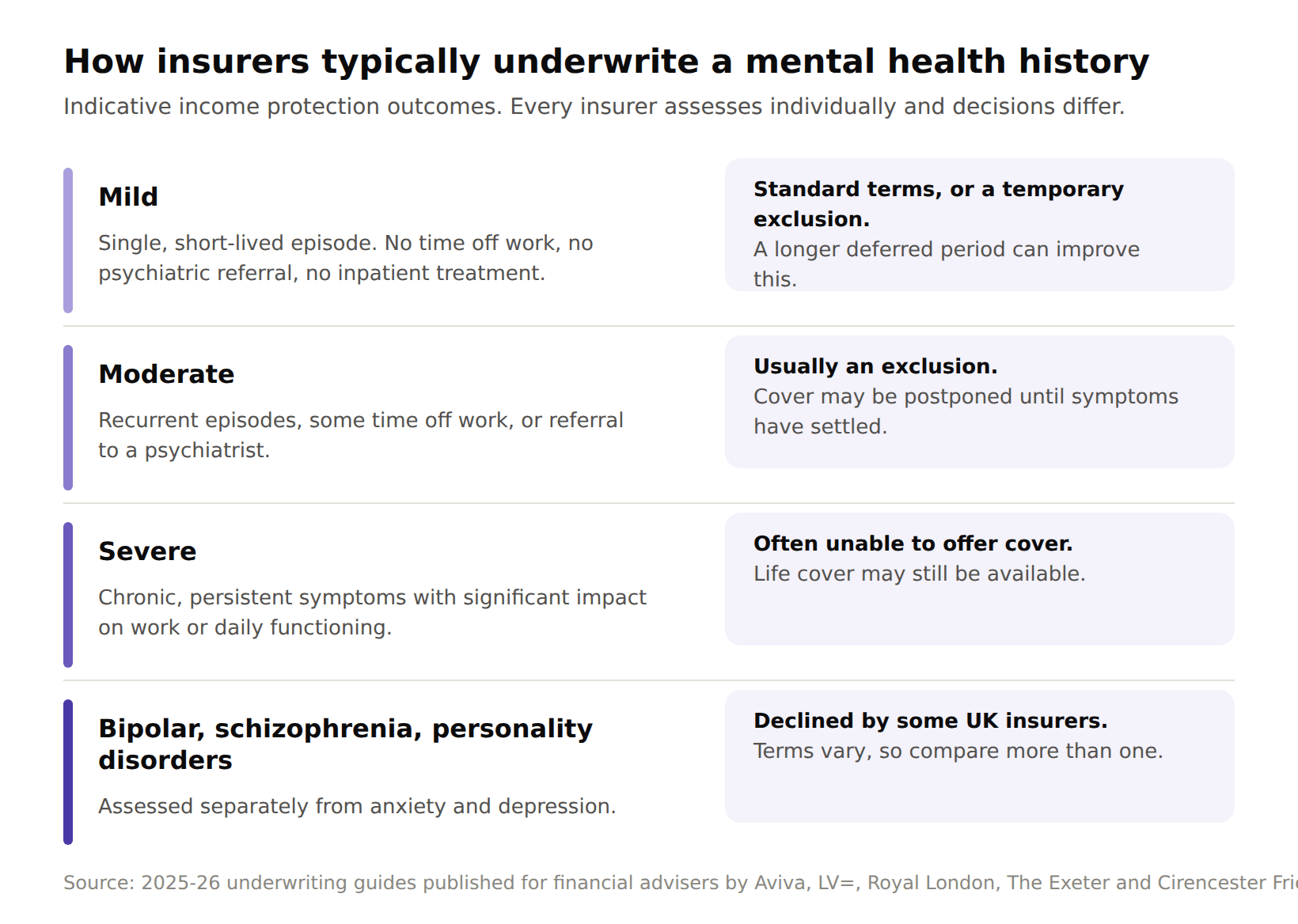
Every insurer stresses that mental health is assessed individually. The factors they weigh are consistent: the diagnosis, when symptoms started and last occurred, how many episodes there have been, the treatment received (GP care, counselling, CBT, medication, inpatient treatment), how much time you have had off work, the impact on daily functioning, and any history of self-harm or suicide attempts.
Time since your last episode is the biggest single factor
If you take one thing from this section, take this. Insurers care less about the label than about how long ago it was and how much work you missed.
LV='s published guide is the most granular on this point. For anxiety or depression, its indicative income protection outcomes run as follows:
| Your history | Indicative income protection outcome |
|---|---|
| Single short episode more than three years ago | Usually ordinary rates |
| Single episode within the last three years, no time off work | Usually an exclusion |
| Single episode within three years, two months off work | Exclusion |
| Multiple episodes, the last more than a year ago | Exclusion |
| Any history involving psychiatric referral or hospitalisation | GP report needed before a decision |
The three-year mark is doing a lot of work there. If your last episode was two and a half years ago and you are not in a hurry, waiting can change the answer from an exclusion to standard terms.
The Exeter uses a similar frame, noting that episodes within the last five years usually result in an exclusion, with terms depending on severity, recurrence, time off work, hospital treatment and any self-harm or suicide attempts.
The same history, five insurers, five answers
This is the strongest argument for not giving up after one application. Take a single, mild, past episode of anxiety or depression with no inpatient treatment, and compare what each insurer's own published guide indicates for income protection.
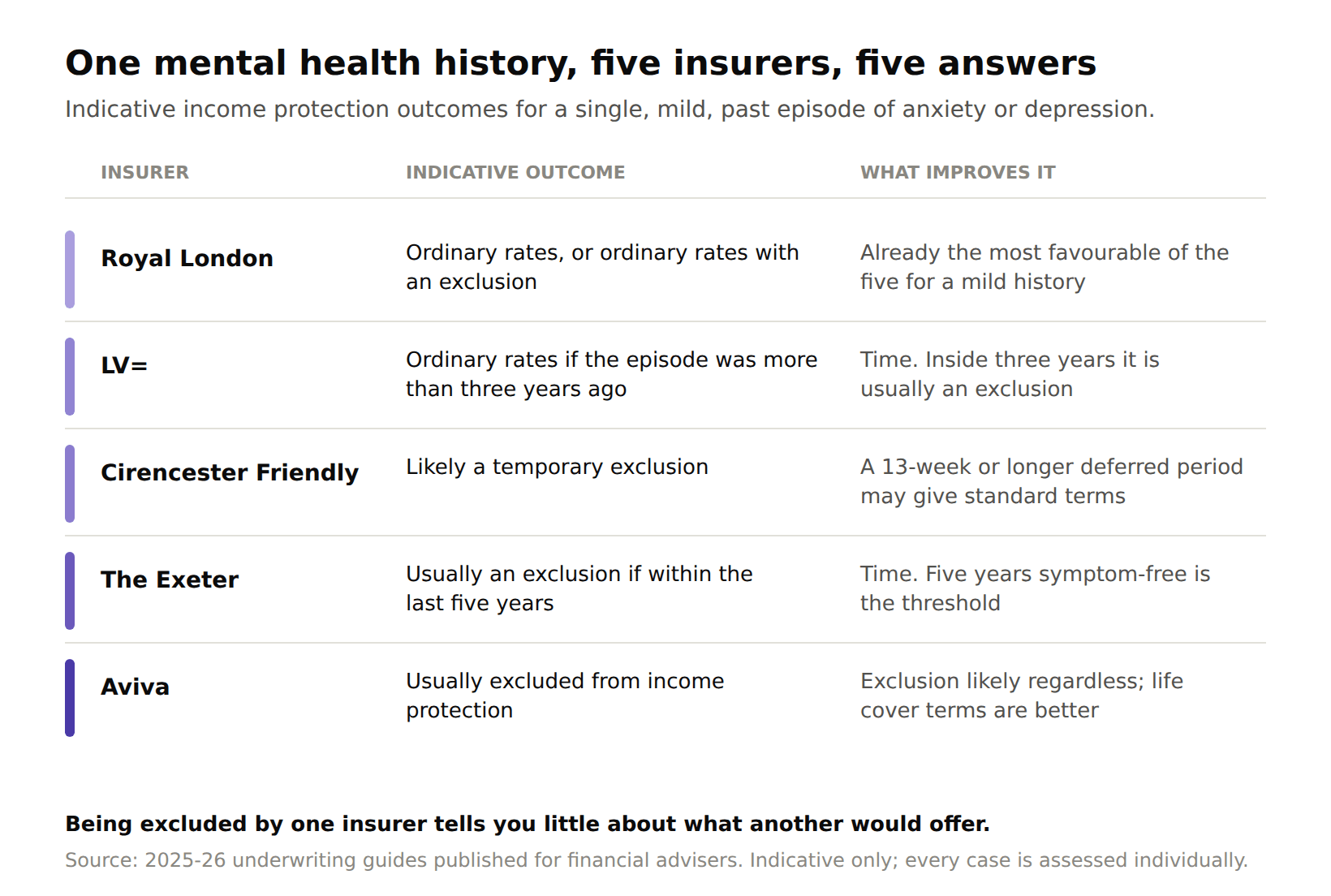
Same person, same history, materially different answers. Notice too that each insurer has a different lever: for LV= and The Exeter it is time since the episode, for Cirencester Friendly it is the deferred period, and for Aviva the better route may be life cover instead. Being excluded by one insurer tells you very little about what a second would offer, which is exactly why a protection adviser with access to the whole market earns their fee on a case like this.
The same history often gets better terms on life cover
Worth knowing if income protection proves difficult: mental health is underwritten far more leniently for life cover than for income protection, because the risk being insured is different.
The Exeter notes that most mild and well-controlled anxiety and depression attract standard rates on its life product. Aviva indicates that a single episode of mild depression is normally only rated for life cover if there are current symptoms. Royal London shows ordinary rates for life cover on a mild history, against ordinary rates with an exclusion for income protection.
So a history that produces a mental health exclusion on income protection may well produce standard terms on life cover. If protecting your family is part of what you are trying to do, that route may still be fully open.
You can find out where you stand before you formally apply
A declined or heavily loaded application is not something you want on your record if it can be avoided, and it does not have to be a leap in the dark.
Most insurers now decide the majority of applications immediately: Aviva reports that around eight in ten customers receive an immediate underwriting decision. Several also run pre-underwriting services that give an indicative answer before an application is submitted. LV= offers advisers a pre-underwriting tool that returns indicative decisions and confirms what medical evidence would be needed, and Cirencester Friendly publishes a direct line to its underwriting team for cases its guide does not cover.
If you have a mental health history, ask an adviser to run a pre-underwriting enquiry first. You get a realistic picture of your terms without a formal application.
Disclosing is more humane than it used to be
If the prospect of writing your mental health history into an online form is off-putting, it is worth knowing there are other routes. Cirencester Friendly lets applicants disclose through online questioning or a nurse tele-interview. Aviva notes that its underwriters are specifically trained for the sensitive nature of these conversations, and asks for your contact preference on the application form so any follow-up happens the way you would prefer.
Mild, single episodes
A single, short-lived episode of mild anxiety or depression, particularly one connected to a specific life event such as bereavement, is the most favourably treated scenario.
Royal London's guidance indicates ordinary rates, or ordinary rates with an exclusion, for income protection in these cases. LV= indicates ordinary rates where the episode was short and more than three years ago. Cirencester Friendly notes that mild depression, anxiety or stress, meaning cases without inpatient treatment or referral to a psychiatrist or psychologist, need only be disclosed if present in the five years before applying, and are likely to lead to an exclusion on a temporary basis.
Moderate or recurrent episodes
Recurrent episodes, referral to a psychiatrist, or some impact on work and functional ability push things further. Royal London's guidance points to ordinary rates or a postponement for income protection at this level. LV= indicates an exclusion for multiple episodes, and requires a GP report before deciding where there has been a psychiatric referral or hospital admission.
Aviva is direct about the reason: because depression and anxiety are a leading cause of disability claims, a history of these conditions will usually be excluded from income protection, total permanent disability and waiver of premium benefits. Where symptoms are recent or worsening, cover may be postponed to give treatment time to work.
Severe or ongoing conditions
Where symptoms are chronic and persistent with significant impact on work or functional ability, Royal London's guidance indicates that income protection is not available. Aviva similarly notes that where there has been a lot of time off work, or more severe symptoms, it may not be able to offer cover at all.
Bipolar disorder, schizophrenia and personality disorders
These are treated differently from anxiety and depression. Cirencester Friendly states plainly that it cannot offer terms for applicants with a history of bipolar disorder, manic depression, schizophrenia or borderline personality disorder, and lists them among its automatic declines.
If this applies to you, it is worth knowing upfront rather than discovering it through a declined application. It is also worth knowing that insurers differ, and that life cover is often available where income protection is not.
Why a longer deferred period can help
Here is a practical lever most people never hear about.
Cirencester Friendly's guidance notes that on higher deferred periods of 13 weeks or more, it may be possible to offer standard terms for mild mental health histories, depending on individual circumstances, where a shorter deferred period would attract an exclusion.
LV= corroborates the principle from the other direction, noting that for income protection its indicative loadings and evidence requirements are a general guide that may vary depending on the waiting period chosen.
The logic is straightforward. Most mental health absences resolve within a few months, so an insurer carries much less risk on a policy that only starts paying after three months. If you have a mild history and can manage a longer wait, perhaps because you have savings or contractual sick pay, extending the deferred period may get you cover without a mental health exclusion at all.
That single adjustment is often the difference between a policy that covers the risk you are most worried about and one that does not.
What to check in a policy if mental health matters to you
Several features of an income protection policy have direct implications for mental health cover. It is worth understanding them before you buy, because they may influence which policy you choose. Eleos offers income protection, and you can see how these points are handled in the Eleos policy terms and conditions.
| What to check | Why it matters for mental health | Question to ask |
|---|---|---|
| Definition of incapacity | Determines whether a claim succeeds when you could do some work but not your own job | Is it own occupation? |
| Disclosure window | Sets how far back you must declare a past episode | How many years back does the health question reach? |
| Personal exclusions | A mental health exclusion removes the most likely cause of claim | Is there an exclusion, and is it reviewable? |
| Review date | An exclusion applied today need not be permanent | When is it reviewed, and what removes it? |
| Deferred period | A longer wait can turn an exclusion into standard terms | What changes if I move from 4 weeks to 13? |
| Support services | Early help affects recovery, and recovery affects your income | Is there a mental health pathway, counselling or therapy access? |
The definition of incapacity
Check that the definition covers mental illness explicitly, and check which of the three definitions above applies. Own occupation is the strongest.
Pre-existing conditions and disclosure windows
Most insurers will not cover conditions you are already experiencing when you apply. Many limit disclosure to conditions active within a set window, commonly the last five years for mild mental health histories.
A word on the disclosure duty itself: since the Consumer Insurance (Disclosure and Representations) Act 2012, your obligation is to take reasonable care not to make a misrepresentation, which means answering the questions you are asked fully and accurately. Being straightforward here protects the claim you may need later.
Personal exclusions and review dates
Personal exclusions are added because of your own history. If one is applied, ask two questions before accepting: is there a review date, and what would need to happen for it to be removed?
Several UK insurers add review dates to exclusions, often one to three years after cover starts, and the ABI notes it is worth revisiting cover in future because terms can improve after symptom-free years. An exclusion applied today is not necessarily permanent.
Standard policy exclusions
These apply to everyone holding the policy regardless of health, and usually relate to things like hazardous occupations and pursuits. They are broadly similar across providers but not identical, so read them.
Treatment requirements
Some policies require you to follow recommended treatment as a condition of continuing to claim. These can be helpful and are usually reasonable, but check what is being asked of you.
Family history: usually not asked
You may read that insurers ask about family history of mental illness. In practice, the published family history sections of the major UK income protection underwriting guides cover conditions such as Alzheimer's, cancer, heart disease, diabetes, multiple sclerosis, motor neurone disease, Parkinson's and polycystic kidney disease. Mental health does not generally appear among them.
So a relative's mental health history is unlikely to be the reason for an exclusion on your policy. Your own history is what drives the decision. Answer honestly whatever you are asked, but do not assume a family history will count against you.
Mental health support services
Many income protection policies offer more than a monthly payment. The ABI notes that many have specific mental health pathways, alongside rehabilitation support and access to counselling, therapy and wellbeing services. For a condition where early support genuinely affects recovery, this is worth weighing rather than treating as a marketing extra.
Already have a mental health history? Three things to do
- Apply anyway, and be accurate. Mild histories frequently attract standard terms or a temporary exclusion rather than a refusal, and an inaccurate answer risks the claim you are buying the policy for.
- Compare more than one insurer. The four guides referenced here reach materially different conclusions on similar cases. Being declined or excluded by one insurer tells you very little about what a second would offer, and a protection adviser who knows the market is genuinely valuable here.
- Consider a longer deferred period. As above, this is often the single most effective adjustment for getting mental health cover included rather than excluded.
The bottom line
Mental illness is treated by UK insurers with the same seriousness as physical illness, and the claims figures prove it: mental health has been the most common cause of income protection claims in the UK.
If you are healthy now, a policy taken out today will cover mental health conditions that develop later, subject to its definition of incapacity. If you already have a history, cover is often still available, though the terms depend on severity and on which insurer you approach.
If you have been putting off income protection because you assumed mental health would not be covered, that assumption is worth revisiting.
Sources
- NHS England, Mental Health
- Health and Safety Executive, working days lost statistics
- Association of British Insurers, Mental Health and insurance
- LV=, mental health and income protection claims
- Citizens Advice, income protection insurance
- Mind, anxiety disorders and bipolar disorder
- Mental Health Foundation, stress; Mental Health UK, burnout
- NHS, depression in adults and PTSD
Insurer underwriting guides referenced
All are published for UK financial adviser use. Editions used for this review:
| Insurer | Guide | Edition |
|---|---|---|
| Aviva | Understanding Underwriting (PT15357) | April 2026 |
| Royal London | Measuring Risk (P8G0011/15) | June 2026 |
| LV= | Protection Underwriting Guide | current edition at August 2026 |
| The Exeter | Income First & Real Life Underwriting Guide (MKTG376) | November 2025 |
| Cirencester Friendly | Our Guide to Underwriting (V5) | August 2025 |
Underwriting practice changes. These positions are indicative of each insurer's published guidance at the date of review and are not a guarantee of the terms any individual would be offered.
This guide is for general information and is not financial or medical advice. Underwriting outcomes are assessed individually and vary between insurers, so nothing here is a guarantee of the terms you would be offered. Policy definitions, exclusions and features vary. Always read the policy documents and consider speaking to a regulated protection adviser before you buy.
Does Income Protection Cover Mental Health? A UK Guide for 2026
Frequently asked questions
Fact-checked and reviewed by Kiruba Shankar Eswaran or another licensed agent on our team. Read our editorial standards.
This guide is for general educational purposes and is not financial advice. Cover, eligibility and terms vary by insurer and by policy. Always read the policy documents for the full terms, limitations and exclusions before you buy.