What Is Embedded Insurance? Explained by Who Pays for It


Ask ten people what embedded insurance means and you get ten answers, because the word describes where insurance is sold, not what it is. A travel policy sold on an insurer's own website is just a travel policy. The same policy offered inside an airline checkout is embedded. Nothing about the cover changed. The journey did.
The useful way to sort it is two questions. Who pays the premium? And how much of the insurance company do you actually see?
Who pays
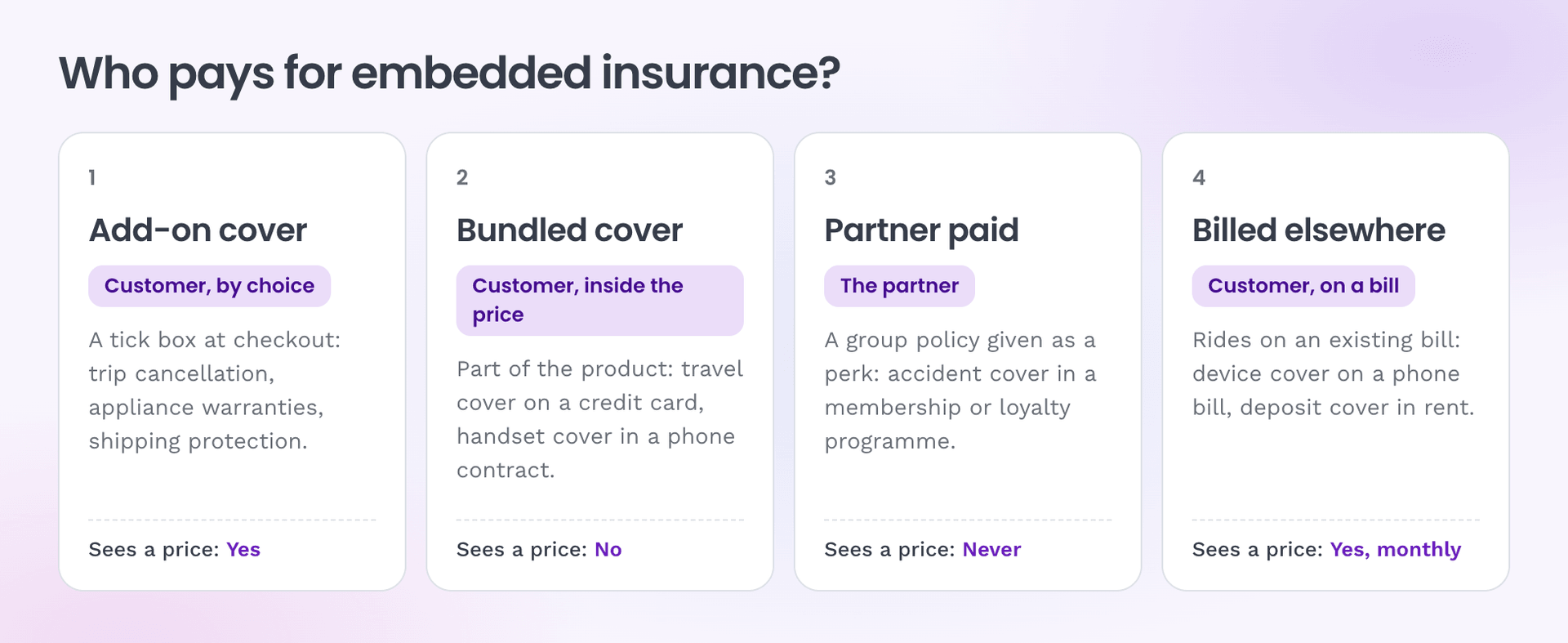
1. Add-on cover: the customer pays, and chooses to
This is the oldest form and still the most common. You are buying one thing, and at the moment of purchase you are offered cover for it, priced separately, as a tick box or a pop-up.
Book a flight and the airline offers trip cancellation cover before you pay. Buy a washing machine and the retailer asks if you want five years of breakdown cover for another ninety pounds. Order something online and the checkout offers shipping protection for a couple of pounds more.
The customer knows they bought insurance, because they saw the price and said yes. Take-up lives and dies on timing: the offer lands at the exact moment the risk is on the customer's mind. Nobody wakes up wanting shipping protection. Plenty of people want it in the thirty seconds after paying for something fragile.
This model suits anything bought in a single transaction: travel, tickets, electronics, appliances, jewellery, parcels. Firms like Extend and SquareTrade run the warranty end of it, Cover Genius and Allianz Partners run a lot of the travel end.
2. Bundled cover: the customer pays, inside the price
Here the cover is part of the product and there is no separate line item. The cost is in there, the customer just never sees it broken out.
The classic example is the credit card. Pay for a trip with the card and you get travel cover, pay for a phone and you get purchase protection, hire a car and the collision cover may already be handled. The card issuer negotiated a group policy, priced the cost into the card's economics, and every cardholder is covered whether they read the benefits booklet or not.
TruStage works on similar logic in US credit unions, where members get a small amount of life cover as part of the relationship. Phone contracts do it too when handset cover sits inside the monthly bill.
Bundled cover matters to the partner because it is a reason to pick their product over a rival's, not a product in itself. It matters to the customer because they are often covered without knowing it, which cuts both ways: free cover is welcome, unclaimed cover because nobody knew it existed is a standing criticism of this model.
3. Partner paid: the customer pays nothing
The partner buys a group policy and gives the cover away. A bank, lender, membership body or employer pays a per person rate, and every customer or member gets the cover as a perk.
A mortgage lender might include a period of accident cover with a new loan. A membership programme might add a small life or accident benefit to make the membership harder to leave. The customer never sees a price, never fills in an application, and in some cases never gets told in terms they will remember.
This is the quietest form of embedded insurance and, pound for pound, often the cheapest cover a person holds, because group pricing on thousands of people beats individual pricing almost every time. It is also the form where the partner's motive is plainest: retention. The cover is there to make leaving feel like losing something.
4. Customer pays, but somewhere else
Sometimes the premium is real and the customer pays it, just not at a checkout. It rides on a bill they already pay.
Device protection inside a mobile phone contract is the obvious case: a monthly amount on the same bill as the data plan. Rhino's security deposit cover in the US works this way too. A renter pays a monthly premium instead of handing over a cash deposit, and the payment sits inside the renting relationship rather than a one-off purchase.
This suits cover that runs as long as the underlying relationship runs. The phone is insured while the contract lasts, the deposit cover runs while the tenancy lasts. Cancellation is also simpler: end the relationship and the cover ends with it.
How visible is it?
The second question is about branding, and it decides how the customer remembers the experience.
White label means the partner's brand is on everything and the insurance provider stays out of sight. The quote pages, the documents, the emails all look like the partner's own product. This is how Eleos and Wakam work. The partner gets the credit when it goes well, which is the point, and the provider's job is to be invisible and reliable.
Co-branded means both names show. Common with large insurers working with large retailers or airlines, where the insurer's name is itself a reason to trust the offer.
Provider branded means the cover sits inside the partner's journey but is plainly the insurer's product. Allianz travel cover in an airline checkout is the standard example. You bought it during someone else's purchase, but you are under no illusion about who insures you.
Branding is not decoration. It decides who the customer calls when something goes wrong, whose name is attached to a refused claim, and who owns the relationship when the policy comes up for renewal.
How it actually works
Strip away the marketing and the mechanics are the same in every model.
The insurance provider connects to the partner's app, website or checkout, usually through an API. The offer appears at the point where it makes sense: the booking, the purchase, the loan completion, the tenancy signing. The customer accepts, the policy is issued there and then, and the premium moves with the main transaction or the group arrangement behind it.
Licensing is the part partners care about most. Selling insurance is regulated, so the provider normally holds the permissions, does the underwriting, carries the risk and handles the claims. The partner distributes. That is what makes the model attractive to a retailer or a lender: a new revenue line and a stickier customer, without becoming an insurance company. The partner earns a share of each premium sold through its brand.
So how do you describe it?
Badly, most of the time, because one word is doing too much work. Embedded covers a ninety pound warranty tick box and a group life policy covering a million credit union members, and those two things have almost nothing in common beyond the sales channel.
The working definition that holds up is this: cover offered inside another product's buying journey, at the point where the need arises, paid for by the customer, by the partner, or split between the two.
If you are buying it, ask the two questions this article started with. Who pays, and whose name is on it when a claim goes in? The answers tell you more about what you are getting than the word embedded ever will.
To see who does what in the UK, read our list of 20 embedded insurance companies. If you want to add embedded life insurance or embedded income protection to your own product, talk to our partner team.
Fact-checked and reviewed by Kiruba Shankar Eswaran or another licensed agent on our team. Read our editorial standards.
This guide is for general educational purposes and is not financial advice. Cover, eligibility and terms vary by insurer and by policy. Always read the policy documents for the full terms, limitations and exclusions before you buy.
Related resources
High Value Life Insurance: Cover Over £1 Million (2026 Guide)
There is no fixed UK maximum for life cover. See how much you can get above £1 million, what medical and financial evidence is needed, and the real limits.

How One Change Helped Nubank Generate $150M in Passive Revenue
To be competitive in today’s neobanking landscape, Nubank knew they needed to go beyond the basics. They needed a way to deepen customer relationships while generating passive income: and embedded insurance was the key.
8 Embedded Finance Companies in the UK to Watch
Embedded finance companies in the UK are revolutionising the way we interact with our finances every day. For consumers, it’s about convenience: embedded finance companies offer streamlined services on trusted platforms they already know and love. For brands, it’s a groundbreaking way to scale growth faster than ever before.

Introducing Theea's Coverage Calculator
The intuitive insurance tool inspired by thousands of customer conversations that turns anxiety into tailored advice and confusion into confident choices.

20 Embedded Insurance Companies in the UK (2027)
What 20 embedded insurance companies in the UK sell, what they publish about fees, how much you can change and how quickly you can launch.

Gamification in the insurance industry
How businesses are using the techniques of gaming to increase customer engagement and grow their revenue