20 Embedded Insurance Companies in the UK (2027)

Embedded insurance is cover sold inside another company's product, app or checkout, instead of on its own. We work in this market, so we get the same question most weeks. Which embedded insurance companies operate in the UK, and what do they charge?
The first bit is easy to answer. The second bit isn't. Almost nobody puts partner fees on their website. Two or three do, in part. The rest will talk to you for an hour, show you a lovely demo, and only get to money in the proposal. That's not a criticism, exactly. Deals do differ. But it makes comparing firms a slog, and it's why the questions you ask at the start matter more than the product pages.
So here's our list of embedded insurance companies and providers. Twenty firms selling in the UK, or helping other people sell here. What they sell, what (if anything) they've put in public about money, how much of the product is theirs and how much you can bend it, and the bits we'd check twice before signing anything.
One warning before the table. These firms aren't interchangeable. Some provide the insurance. Some run a scheme for somebody else. Two on the list, KASKO and Tigerlab, don't sell insurance at all. They sell software. If you go to them you still need an insurer, and you still need your permissions sorted. People mix that up all the time.
The 20 embedded insurance companies, on one page
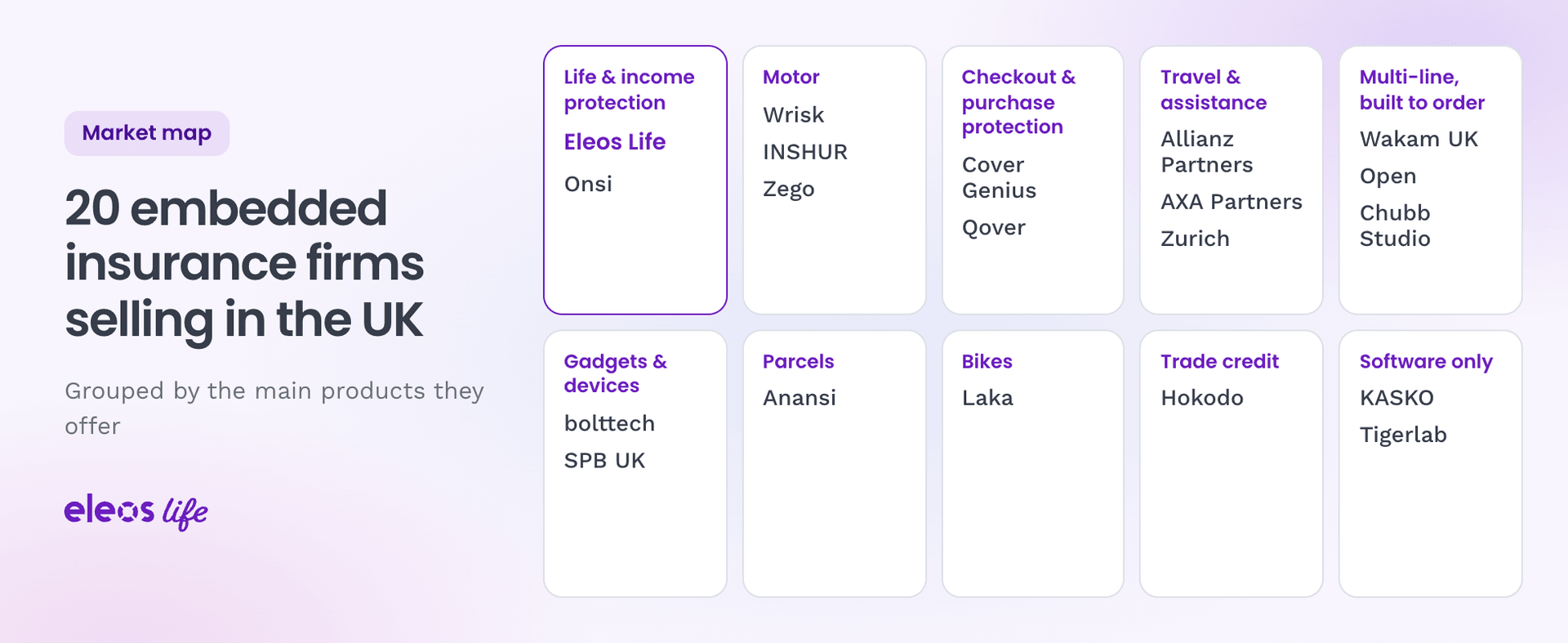
Fees public means partner fees, not the price a customer pays, unless it says otherwise.
| Company | Main products | Fees public? | How much can you change? | Launch |
|---|---|---|---|---|
| Eleos Life | Term life, income protection | Yes: £0 setup and platform | Set products, your branding and settings | Referral links in days, white label pages in a couple of weeks, most API embeds within a quarter |
| Wakam UK | Made to order cover across motor, home, pet, health, gadgets, travel | No | Built to order | Pricing in about 30 days, launch about 90 days on average |
| Cover Genius | Travel, warranties, shipping, purchase protection, rental cars | Big deals no, small business part | Configured to tailored | No standard time published |
| Qover | Purchase protection, warranties, tickets, gadgets, travel, motor | No, structure only | Configured | Weeks, about 3 weeks claimed for some programmes |
| bolttech | Gadget cover first, plus motor, home, travel, health | No | Off the shelf plus tailored work | No UK time published |
| Wrisk | Motor for car makers only | No | Built to order, motor only | Not published |
| INSHUR | Commercial motor for courier and private hire work | Partner no, driver fees part | Set up per platform | Not published |
| Zego | Motor for solo drivers, delivery and taxi | Partner no, driver prices yes | Product settings, not white label | Not published for partners |
| Hokodo | Trade credit at B2B checkout | Model yes, rate no | Modular, you set the options | Plugins and hosted checkout in hours |
| Anansi | Parcels lost or damaged in the last mile | Yes, flat rate on a partner listing | Settings inside one product | Big launches not published |
| Onsi | Accident, sickness and leave for gig and shift workers | No | Configured to bespoke, inside worker benefits | Not published |
| KASKO | Software to build and run products | No, old terms only | Built to order software | 3 to 10 weeks in the cases they cite |
| Laka | Bikes and e-bikes only | Partner no, retail model explained | Settings inside bike cover | Not published |
| SPB UK | Gadgets, lifestyle schemes, warranties, claims handling | Partner no, retail prices yes | Built with you, from set parts | Not published |
| Open | Car, home, travel, landlord, gadgets | Partner no, customer fees yes | Three ways, from ready made to full white label | Not published, ready made is faster |
| Chubb Studio | Phones, travel, accident, home, small business | No | High, for large partners | Not published |
| Allianz Partners | Travel, health and life, help at home, devices | No | Configured to bespoke, large partners | Not published |
| AXA Partners | Help services, travel, home emergency, breakdown | No | White label and built with you | Not published |
| Zurich | Travel at scale, other lines through partners | No | White label in travel, modular through Qover | Not published for the UK |
| Tigerlab | Policy, billing, claims and distribution software | Structure only, no amounts | Highest for software, you set it up | Changes in days, once the platform is in |
Read the fees column the way you'd read a menu with no prices. If it says yes, you can do some maths today. If it says part, you can see what a driver or a shopper pays, which isn't the same thing at all. If it says no, the first proper number will arrive in a proposal, probably after the second meeting.
Life and income protection. That's us, mostly alone
Eleos Life
We'll go first because we're the odd one out on this list. Eleos sells two things in the UK: embedded term life insurance and embedded income protection. Nothing else.
Term life runs from 5 to 20 years, £5,000 to £250,000 of cover, and starts at £5 a month. Income protection covers accident, sickness and redundancy, up to about 60% of income, with the redundancy part paying up to £2,000 a month for 12 months. Every policy comes with bits people actually use before anything goes wrong. An online GP. Counselling. Physio. A health check, and The Body Coach app.
Partners we've named in public include Loqbox, CreditLadder, Creditspring and Updraft.
On money, we can be short because we've published it. There's no setup fee and no platform fee. The partner earns a share on every policy sold, and the customer pays their own premium. What we haven't published is the share as a percentage, and you should ask us for it in writing, along with what happens if a policy cancels in the first year, whether the share keeps paying after year one, and whether the free perks could ever get repriced.
You can't redesign the products. They're set, deliberately. What you do get is your name on the whole thing, and cover sized from data you already hold. If someone's salary lands in an account with you each month, the suggested cover can follow that salary instead of asking them to work it out.
And the bit people usually query: how fast can it go live? Referral links go live in days, with no engineering. White label pages typically take a couple of weeks. A full API embed depends on your roadmap, but most partners ship within a quarter.
Onsi
Onsi sits near us on paper and does something quite different in practice. It sells cover for gig and shift workers: accident and sickness, public liability up to £5 million, compassionate leave, family leave, sick pay. Around that there's an online GP, physio, counselling, early pay, rewards and savings pots. Wolt, Ryde, Gophr, Indeed Flex, TaskRabbit and Evri have all used it.
Business pricing isn't published. There's a line on their site about cover costing less than a coffee per worker per month. Fine as a line. It isn't a tariff.
What to pin down: price per worker, per shift or per hour? Minimum numbers? Who actually provides each bit of cover, because Onsi isn't an insurer, and what cut do they keep? Programmes get built around tiers, so a courier who does more jobs gets more cover. Ryde and Gophr both work that way. You won't find a public API or a white label offer, it's their app and their dashboard.
The one that builds whatever you ask for
Wakam UK
Wakam is the name that comes up whenever someone wants something odd built. Motor, bikes, pet, home, health, gadgets, travel, even cover tied to crypto. They make it to order, other firms sell it, and their partners list reads like a roll call of UK insurtech: Marshmallow, INSHUR, Cuvva, Urban Jungle, ManyPets, Laka, Onsi, Zego. ManyPets MoneyBack pet cover is one public example of a Wakam scheme.
Fees? Nothing published. They talk about sharing profit from day one and splitting things fairly. No numbers behind either phrase. So ask how profit is worked out, how often it's paid, whether a bad first year carries forward, who sets the customer's price, and what their Play and Plug system costs you, if anything.
Timescales are published, which helps. Pricing in about 30 days, launch in about 90 on average. That's slower than most on this list and it's the trade you make for something built for you.
Now the bit you can't skip. In September 2026 the French regulator stopped Wakam SA, the French parent, writing new business. In October, AmTrust International acquired Wakam SA and Wakam UK, and said the business was fully capitalised. Italy's regulator has since said Wakam can write new business again. Wakam UK is regulated in London and was outside the French ban. Still. Ownership changed, the parent had a regulator problem, and a lot can shift in a few months. Check the position again before you sign, not the week after.
Motor, where the UK firms are strongest
Wrisk
Wrisk does one thing and, by the look of the client list, does it well. Motor insurance for car makers.
BMW and MINI were first, back in 2018. Since then: Jaguar, Land Rover, Mercedes-Benz, Volvo, Kia, Mazda, Suzuki, Volkswagen vans, and a twelve brand deal through Stellantis. The products are the ones you'd expect once you think about how cars get sold now. A few days of free cover when you pick the car up. A monthly subscription policy that rolls on instead of renewing once a year. Pay by mile, which they built with RAC.
Roughly 80,000 policies and about £75 million of annual premium, on their numbers, and the UK business is profitable. Allianz is both a big insurer behind the schemes and, since January 2026, a shareholder.
No partner fees are public. None. If you're a car maker you'll want to know whether they take a share of premium, a fee per policy, a licence fee, or all three, who keeps renewal money, and who pays for those free driveaway days. Someone does.
The branding is the real offer here. Wrisk talks about white labelling down to the atomic layer, which is a grand way of saying it doesn't look like a link out to an insurer. It looks like the car brand, start to finish. Within motor, they'll build what the brand wants. Outside motor, they're not interested, and they don't pretend otherwise.
INSHUR
INSHUR covers people who drive for apps. Courier work for Uber Eats, Deliveroo, Just Eat, Evri and Amazon Flex, on 30 day or annual terms. A by the minute product for Amazon Flex drivers called Pay As You Flex. Uber private hire, taxi and chauffeur work. Vans carrying their own goods. Tools and liability cover comes through Markel, not INSHUR itself.
What a platform earns from all this isn't published. What a driver pays is clearer, on one product at least: Pay As You Flex has a £1.49 wallet fee every 30 days, no setup fee and no deposit. Ask what the per minute rate is for your drivers, how the 90 day price lock works in practice, and what share, if any, comes back to the platform.
There's no white label offer and no public API. Their brand, their screens, their dashboard. The product does change by platform, because an Amazon Flex block isn't the same risk as a Saturday night private hire shift, and platform data feeds the price.
One thing worth knowing: in the UK the insurance behind INSHUR comes from Wakam UK. So everything in the Wakam section above applies here too.
Zego
Zego started in the gig economy and has gone back to basics. It sells motor cover to individual drivers now. Its own about page says so plainly: not fleets, not firms buying in bulk. Older pages about fleet deals are still floating around the internet. Ignore them.
What's left: car cover priced using its Sense app, which watches how you drive, or at a fixed price. Learner drivers. Private hire and taxi. Food delivery by car, scooter or van, paid by the minute with a one hour minimum, by the month, or by the year.
Driver prices are public and specific, which we like. Pay as you go delivery cover up to £3.29 an hour for a car, £0.77 for a scooter. Taxi cover from £1,977.90 a year. No admin fees on the 30 day policies.
Partner fees aren't public, and it's fair to ask whether there's a partner fee at all. Platforms can plug in to check whether a driver is covered and to log shifts starting and ending. That's the embed, really. Cover levels and extras come off a menu. Zego's brand and Zego's app stay in front of the driver throughout.
Cover at the till, and cover for parcels
Cover Genius
Cover Genius is the scale play. XCover, their system, will sell you almost any line of protection inside somebody else's checkout. Travel, including cancel for any reason. Rental cars. Shipping. Warranties. Purchase protection. Renters cover, cyber, and cover for gig workers. Partners include Booking.com, Ryanair, eBay, Amazon, Wayfair, Klarna, Revolut, Uber and SeatGeek. If you've bought a ticket or a sofa online in the last few years you've probably been offered their cover without knowing the name.
Money: big deals are priced case by case, nothing published. Smaller shops get a published offer through an app called XCover Go, from $0 a month, with up to 80% commission to the shop on warranty sales. Don't read that across to an enterprise deal. You won't get the same terms and neither will we.
Their system prices in the moment, for that customer, in that checkout, and it tests prices and layouts as it goes. That's the strength and the thing to question. Who signs off a price change? How do you show the price was fair for that customer? Is claims included in their cut or charged per claim? The sale looks like your brand. The servicing afterwards carries theirs, so customers do see the name eventually.
Qover
Brussels based, working in 32 countries, and you'll know Qover's work even if you don't know Qover. Purchase protection on Revolut's paid plans. Travel cover bundled with Yonder cards. Motor programmes for car brands like NIO, and BMW and MINI. Purchase and refund protection, warranties, ticket cancellation, gadget cover, bill cover, accident cover, travel.
No amounts are published anywhere. One write up of an interview with their chief executive described the model as three parts: a flat fee, a tech fee, and a fee per ticket. We'd treat that as a question, not an answer, and it's a good one to open with. Ask what counts as a ticket, because that definition could cost you real money at volume.
Qover's pitch is that it can set up pretty much any combination of product, country and insurer, and that simple programmes can be live in weeks, about three weeks for some. Branding is flexible: their white label pages, or their cover built into your own app.
bolttech
Start with phones. Device cover is bolttech's home ground, with repair and replacement wrapped around it, sold through phone makers, networks and big retailers. After that it gets broader: motor, home, travel, health and lifestyle cover in Europe, run with partners. AXA Partners is the big one for the EU, UK and Switzerland. In the UK there's also motor cover for BYD electric cars, in four other European markets as well, and home packages that bundle gadgets, cyber help and help around the house. They talk about a catalogue of more than 6,000 products.
Nothing on fees is published. There are sites out there quoting bolttech take rates and partner shares. We found no source for any of them on bolttech's own pages, so we'd ignore the lot.
The UK is new territory for them. Most of the launches we found are 2025 and 2026. That doesn't make them a bad bet, it does mean you should get the boring bits in writing early: which UK firm signs your contract, who answers for treating customers fairly, and what the minimum volume is for a UK only deal. Their model suits firms that want five countries, not one.
Hokodo
Different animal. Hokodo isn't selling your customers insurance for something they bought. It's letting one business sell to another business on terms, and covering the seller if the buyer never pays.
A quick credit decision at checkout, cover for non payment, fraud and chargebacks, funding so the seller gets paid up front, and somebody else chasing the late payer. Terms from 7 to 120 days, with 30, 60 and 90 the usual ones. Quick limits up to £20,000 or €25,000. Online, in store, and over the phone.
The model is public. The seller pays a small percentage of each order that's put on terms, and the buyer normally pays no interest and no fees. The percentage isn't public, and neither are setup or monthly fees. Ask for the percentage by term length and by risk band, in a table, before you integrate anything. And ask whether it's worked out on the total including VAT and delivery. Those two answers change the maths.
Setup is genuinely quick on the light options. There are plugins for Shopify and Magento, and a hosted checkout they say can be live in hours. Their name is visible to buyers, though. The buyer pays Hokodo, so there's no pretending it's all you.
Old pages name Lloyd's firms as the backers. Current ones name AIG UK. Get them to confirm who's behind your scheme in the proposal itself.
Anansi
Anansi does parcels. Lost or damaged on the way to the customer, across more than 1,400 couriers, plus delays on UK to UK deliveries. Cover pays up to the full shop price plus postage, which is more than courier compensation usually manages, and claims that fit the set rules get agreed within 72 hours. Normal limit £25,000 a shipment. There's a bigger version for large retailers that goes to £100,000.
It's also one of the only firms on this list with a rate you can quote back at them. A partner listing gives 1.5% of the shop value for UK to UK and 1.8% for international, no excess, paid monthly. Their own site now talks about pricing off your past losses for bigger volumes, so the flat rate may be the small shop offer. Worth asking at what size they switch, whether that percentage sits on value including VAT and postage, and what happens to your price at renewal after a bad quarter.
You set the floor and ceiling for which orders get covered, you pick shop price or cost price, and you can pause it. It links by API or by file upload, so the checkout doesn't change.
Small print: the firm overseeing them has changed recently. Check the FCA Register for the current position before you rely on it.
Bikes, gadgets, and the software underneath
Laka
Bikes. Just bikes. Theft and third party liability at the basic end, then crash and accident damage and recovery if you pay more, with personal liability, health and recovery, personal accident and legal cover as add ons. E-bikes, cargo bikes and e-scooters count. They'll also try to get a stolen bike back, which is a nice touch and probably cheaper than paying out.
For businesses, Laka bundles cover with connected bikes at the point of sale and runs group schemes for fleets, leasing firms and shops. Decathlon, Brompton, Gazelle, Riese & Müller, Tenways and Ribble are all on the partner list, plus more than 100 dealers after they bought VeloLife.
Partner pricing isn't public. The customer model is, and it's unusual enough to be worth explaining. There's no fixed monthly premium. Everyone in the group pays based on the claims the group made last month, up to a cap set by what their bike is worth, and there's no excess. One secondary source describes the split as 80% to claims and 20% covering Laka and the insurer. Ask them if that's still right.
The obvious problem: a shop at the till wants a fixed number to bundle into a price, and Laka's number moves. Maybe they can fix it for your scheme. Ask. Also ask who pays for the free periods that turn up in their deals, 12 months with some bike brands, 30 days for some shop customers, and who keeps a recovered bike.
There's a light quote API for shops and a fuller one for group schemes. Claims stay with Laka, and their name stays on it.
SPB UK
SPB is older than most of this list put together. The French group goes back to 1965, and the UK side, based in Portsmouth, designs schemes, runs them and handles the claims. Citymain is its lifestyle scheme brand, Burnett does insurance and warranties for smaller firms and schools, and Insurance2Go is the gadget brand you'll see as a customer.
So: phone and gadget cover for phone firms, protection sold at the till and after it in shops, car breakdown warranties, cover inside banking apps and card packages, travel cover from booking to coming home. Gadget cover under Insurance2Go takes in phones, laptops, tablets, watches, headphones, consoles and cameras, for damage, liquid damage and breakdown, with theft, loss and unauthorised use on the fuller version.
Partner money isn't public. Customer prices under their own brand are. Phone cover from about £1.99 to £2.99 a month at the basic level, £3.49 to £5.99 for the fuller one, business gadget cover from £4.49 a month, and you pick your own excess at £50, £100 or £150.
White label is the core of what they do, and they say their modules can be changed fully and plugged in without much work at your end. Claims run through their own platform, with online claims built for each client.
What you won't find is developer documentation or a launch timetable. This is an affinity business that has done the work for decades, not an API firm with a docs site. That's fine for a lot of schemes. It also means there are several UK firms and trading names behind one programme, so get the contracting firm and the insurer's name down for yours.
Open
Australian, with a UK arm in London and an FCA permission of its own. Across the group Open sells car, home, contents, travel, landlord, purchase protection, cyber, life and gadget cover. In the UK the live proof is narrower: travel sold with Avios, car cover, and phone and gadget cover. The UK car panel includes Ageas, Allianz and Covea. Bupa, British Airways Avios, Volkswagen Financial Services, Polestar and Cupra are named partners, though several of those are in Australia and New Zealand, which is where most of their published track record sits.
Partner terms aren't public. Customer fees are, in unusual detail, in their UK terms. £43 to set up a car policy. £5 for tech cover. Travel fees somewhere between £1 and £36 depending on the policy. They also say in plain English that they earn a percentage from the insurer, plus that setup fee, sometimes a profit bonus, and a fee for handling claims. The percentages themselves, no.
You get three ways in. A white label version that's yours from start to finish. A panel where customers pick between insurers. Or Huddle, their own brand, which is the quick one because it already exists. Setup needs no coding, apparently, and you can build cover into your own sale from quote through to claim.
Check, line by line, what's actually for sale in the UK before you plan a launch around the group list. That gap between the two is the main trap here.
KASKO
Software. Let's be clear about that up front, because the website can leave you thinking otherwise.
KASKO sells the kit you build insurance products on. Quote and sale, product setup, pricing and underwriting screens, policy paperwork, payments, a customer area, and a tool for starting a claim. Live examples include single item cover for phones, bikes and TVs, watch cover priced off a photo, contents, travel, accident, cyber and liability cover, and motor extras. Baloise is a big client. In the UK they built the student renter product for Co-op Insurance, phones, laptops and bikes, on a Co-op branded site that KASKO hosted.
Their own numbers: more than 100 products launched, more than 1 million policies, more than £100 million of premium put through the system.
Current pricing isn't public. An interview from 2019 talked about a licence per product, a setup fee and a small success fee, and claimed a product could be live in four weeks. That's seven years ago. Don't budget off it, but do ask the same questions in the same shape: what's the licence based on now, what's setup per product and per partner, does the success fee run on renewals, and what do claims and payments cost extra?
For change, this is near the top of the list. You pick the parts, there's little or no coding for most setup work, and you can change the front end, the price and the documents partner by partner. The cases they cite are fast: three weeks for a Baloise watch product, ten weeks for Co-op.
And on their own description the claims side is a tool for starting a claim, not a full claims service. Budget for that separately.
Tigerlab
Also software, and even more so. Tigerlab sells no policies at all. It sells the systems that run insurance firms: policy records, billing, claims and distribution, covering quote, sale, pricing, underwriting, changes, cancellations, renewals, reports, commission, customer screens and documents. There's a separate system for brokers. Most of its work is business and specialist cover.
Pricing is oddly the most open on this list, in structure at least. Their own site says there are no public plans, they scope the job, and you get one number for the whole thing. Directory listings describe a one off setup fee, a monthly licence and a fee per transaction. No amounts anywhere, and the ranges on round up sites contradict each other, so bin them.
Ask what setup covers per product and per country, what the licence is based on, what you pay per quote, sale, change and claim, and what you can change yourself without paying them to do it. Also hosting, where your data sits, and what you get back if you leave.
For software, nothing else here gives you as much control. Parts you can mix, products you can build without coding, your branding throughout, their servers or yours. Their line about products launching or changing in days refers to a system that's already running, by the way. Not to a first install.
The comparison trap: your real cost isn't Tigerlab. It's Tigerlab plus an insurer, plus a way to sell, plus your own permissions, plus people to handle claims. And the job of showing the product is good value for customers stays with you.
The big groups
Chubb, through Chubb Studio
Studio is how Chubb sells through other people's products. Car, accident, life and health, home, phones, travel and small business cover. UK examples are concrete, which we appreciate: Currys sells Chubb phone cover in two versions, EE has phone cover with more than 500,000 policies on their numbers, and Jove sells professional cover and employers and public liability to tech contractors through Studio.
Fees: nothing. At any level. So the list is the usual one, plus a couple of Chubb specifics. Is their price testing tool, launched in November 2025, charged for separately? Who acts as the regulated seller in the UK on your scheme? What do the little websites and app components cost, and what gets charged back when a policy cancels?
If you're big, you can change a lot. White label, or built with you, delivered as a small website, an app component or a direct link into their systems, and you can run it, they can run it, or you can split it. Their system also shapes the offer to the customer in front of it.
This is built for banks, phone firms, airlines and big retailers. Talks will move at big firm pace. If you're a 20 person fintech, go in with your eyes open.
Allianz Partners
Travel is what most people know them for, and the deals are long ones. TUI's travel cover across 11 markets including the UK and Ireland, renewed for four years from November 2026. Aer Lingus to March 2027. Motor, warranty and roadside help for heycar on a five year deal. Damage, theft and warranty cover for phones and appliances sold by Joybuy, JD.com's European shop, in the UK and elsewhere.
Beyond travel: health and life cover sold internationally, help at home, warranties, day to day living services, and cover for phones, appliances and cyber risks.
No fees are published. One deal in Australia and New Zealand mentioned sellers getting commission up front and didn't say how much, which tells you the shape and nothing else. Ask whether you're earning commission on sales, a flat fee for help services, or a charge per case, because their model mixes insurance with sending a plumber out. Ask what's included and what's licensed separately among their customer systems, what minimum business you need to bring, and who pays when service levels get missed.
Branding can be yours, theirs or a plain white label, and big partners get schemes built for them. We couldn't find a public tech link or a standard way of plugging in. It looks like each programme gets designed on its own.
Last thing: the group was reshaped in January 2026, with motor split away from a new home line. Ask which part of the group, and which system, your scheme would actually sit in. Ask early, not after the term sheet.
AXA Partners
Help services, travel and credit protection are the core offer. In the UK and Ireland that's home emergency, motor breakdown and travel. Home emergency means boilers, plumbing, electrical faults, locks and pests, with more than 4,500 tradespeople behind it, which is a real operation and not a call centre with a script. Through the bolttech deal they also reach motor, home, travel, health and lifestyle cover and gadgets across the EU, UK and Switzerland.
Fees: nothing published, anywhere we looked. Open with whether the price is a share of each policy, a charge per member, or a charge per call out, and what caps sit on call outs, because a cold snap in January will test whatever you agree. Then commission, profit share, and what happens to both if claims run high.
White label and shared branding are the strongest part of the pitch. Products get built with partners and you can pick which risks to include. Claims can be filed online. Selling inside an app in the UK seems to come through bolttech rather than through anything of their own.
Now check this before anything else. In December 2025 Insurance Post reported that, following a Which? super-complaint, AXA Partners' UK travel business needed written FCA permission before entering further corporate partnerships. Where that stands now isn't clear from public sources. Look it up on the FCA Register and get an answer in writing before you plan around them. It may well be resolved. You still need to know.
Zurich
Zurich doesn't have one tidy embedded offer in the UK, and any list that pretends otherwise is guessing.
Travel is the real thing. It's run through Cover-More, which took in AIG Travel and Travel Guard in December 2024. Brands include Travel Guard, Cover-More and Travelex, and they also sell car hire excess and pet cover in the UK and Europe, writing travel business in more than 50 countries. A separate ventures arm covers travel, health and wellbeing, staff benefits, cyber, phones and cars, and bought the cyber firm BOXX in 2025.
Other UK lines tend to arrive through Qover, where Zurich is an investor and also puts its name behind schemes. So if you want life, gadget or purchase cover from Zurich in the UK, you'll probably end up talking to Qover first. Which means two firms taking a cut, and you should price that in rather than discover it later.
Fees aren't published for any of it. Cover-More talks about cover built into a booking, white label deals, deals where the customer pays nothing extra, and platforms for agents. No prices attached to any of them.
Start by asking which route you're actually being offered: Cover-More, the ventures arm, or Qover. Then, if the customer pays nothing extra, who pays per booking? Travel cover can be sold plain white label, and through Qover it comes in pieces you can tailor through one link. UK launch times and tech pages aren't public.
The world travel head office is moving from Sydney to London in early 2027, which may make them easier to deal with from here. Or messier for a year. Ask about run off and who owns your scheme while that move happens.
The questions we'd send all of them
Since most of them won't give you a number until you've had the meetings, send the same questions to all of them, in writing, and put the answers next to each other. It's the only way the comparison means anything.
Is there a setup, build or linking fee, and what does it cover? Is there a monthly platform fee, a fee per policy, or a fee each time your system talks to theirs? What sets each one off?
What percentage do you earn, or pay? Is it worked out on the full price the customer pays, or on what's left after costs? And who sets that final price?
Who owns the renewal? Does commission keep paying for as long as the policy runs?
Is there a profit share? How is profit worked out, how often is it paid, and are losses carried into the next period?
How much do you have to sell? Do you have to work with them alone, and is it cheaper if you do?
Who owns the customer and the data, during the deal and after it?
What do you get on claims? A named service level? Are claims charged per claim or included?
Who provides the insurance behind the product, and what happens to your scheme if they walk away?
What do changes cost? A new product, new wording, a new price, a new screen.
If you leave, can you take your data with you? What export and run off terms apply?
And who has to show the product is fair value for the customer, and who is the regulated seller of record?
Where we'd start, if it were our money
Pick the type of firm before you pick the name. It saves weeks.
Need cover built for you and you're prepared to wait for it? Wakam, or one of the big groups' partner arms. Need a lot of lines in a lot of countries quickly? Cover Genius, Qover or bolttech, and accept that pricing is their game as much as yours. Need one narrow thing done properly, motor for car makers, parcels, bikes, trade credit? The UK specialists on this list will usually talk to you sooner and start sooner. Already got the insurance and the customers, and just need the kit? KASKO or Tigerlab, with the permissions work landing back on your desk.
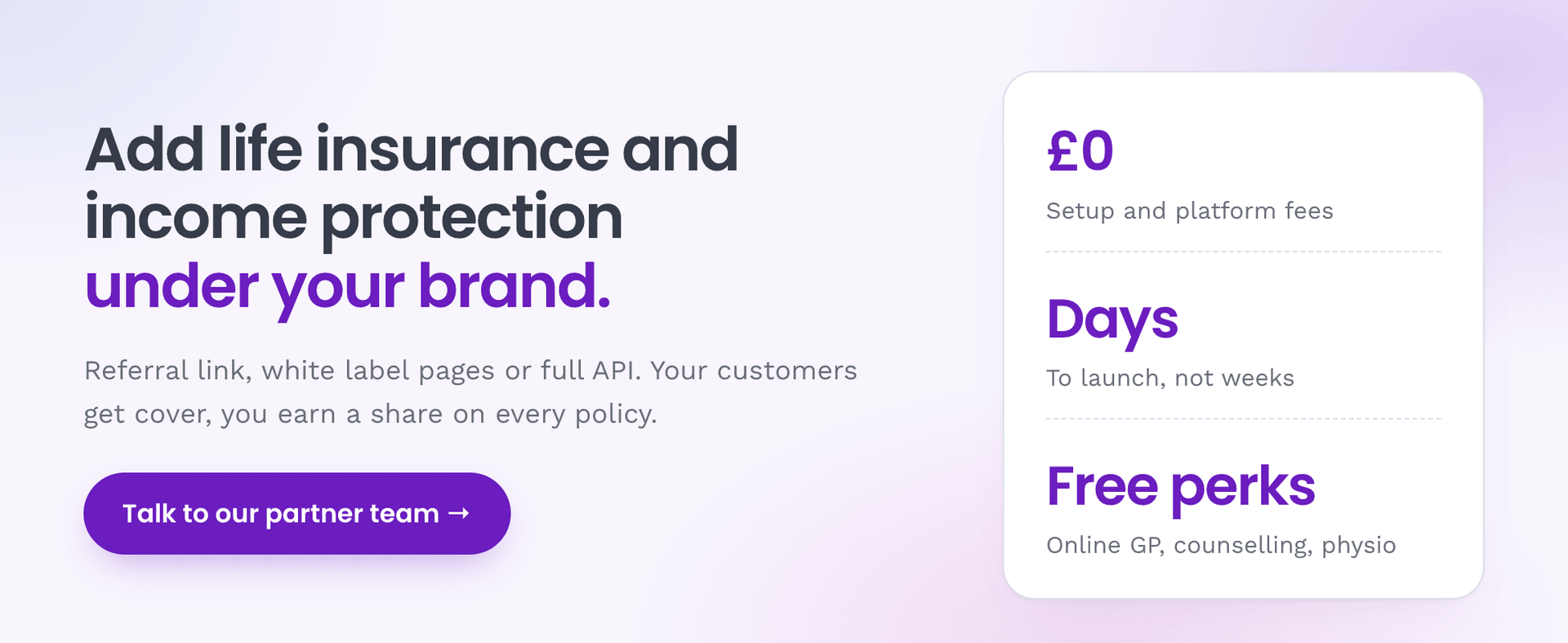
And if it's life or income protection you want to add, a referral link can be live in days. You know where we are.
Fee facts above come from what each firm, or a partner listing naming them, has put in public. Where nothing is published we've said so rather than guess. Prices change and regulatory positions change, so check both again when a proposal lands.
Fact-checked and reviewed by Kiruba Shankar Eswaran or another licensed agent on our team. Read our editorial standards.
This guide is for general educational purposes and is not financial advice. Cover, eligibility and terms vary by insurer and by policy. Always read the policy documents for the full terms, limitations and exclusions before you buy.
Related resources
High Value Life Insurance: Cover Over £1 Million (2026 Guide)
There is no fixed UK maximum for life cover. See how much you can get above £1 million, what medical and financial evidence is needed, and the real limits.

How One Change Helped Nubank Generate $150M in Passive Revenue
To be competitive in today’s neobanking landscape, Nubank knew they needed to go beyond the basics. They needed a way to deepen customer relationships while generating passive income: and embedded insurance was the key.
8 Embedded Finance Companies in the UK to Watch
Embedded finance companies in the UK are revolutionising the way we interact with our finances every day. For consumers, it’s about convenience: embedded finance companies offer streamlined services on trusted platforms they already know and love. For brands, it’s a groundbreaking way to scale growth faster than ever before.

Introducing Theea's Coverage Calculator
The intuitive insurance tool inspired by thousands of customer conversations that turns anxiety into tailored advice and confusion into confident choices.

Gamification in the insurance industry
How businesses are using the techniques of gaming to increase customer engagement and grow their revenue