What is Employment and Support Allowance?


Contents
Commonly shortened to ESA, Employment and Support Allowance is a benefit paid by the Department of Work and Pensions (DWP) to people who have an illness, injury or disability that makes them unable to work. It was introduced in 2008 to simplify the support system that comprised Incapacity Benefit, Income Support and Severe Disablement Allowance.
ESA is frequently associated with long-term and permanent disability because of the prominence given to it by disability charities. In fact it gives support to many people who are experiencing only temporary illness or injury, both physical and mental. It works as an alternative to Statutory Sick Pay (SSP) to help people who are self-employed or whose SSP has expired. SSP is often thought of as government sick pay, but in fact it’s paid by employers to their employees. ESA is commonly described as self-employed sick pay because otherwise, without an employer to provide SSP, there would be no sick pay for the self-employed.
How Employment and Support Allowance works
ESA was designed as a two-element simplification and has since been simplified itself. One element of the benefit has been replaced by Universal Credit but the other remains in force, as we’ll discuss in a moment.
Like all state benefits, you have to apply for Employment and Support Allowance – you won’t receive it automatically as you would Statutory Sick Pay. If you apply and you’re found to be eligible, you’ll be placed into one of two categories and start receiving fortnightly payments. Depending on the category you’re in you’ll keep getting paid for up to 12 months, or your payments may continue indefinitely. We’ll explain this later.
How Employment and Support Allowance Helps
The UK’s welfare state was established in 1945 to reduce poverty and improve public health. It’s been through hundreds of revisions since then, but one of its basic functions has always been to give financial support to people who are out of work. ESA helps people who are unable to work because of physical or mental illness or injury. No one seriously claims that the money it pays is enough to support an average standard of living, but anything is better than nothing. Fortunately extra help is available in the form of income protection insurance.
How is Employment and Support Allowance different from other benefits?
ESA is one of 4 work-related state benefits, the others being Universal Credit (UC), Personal Independence Payment (PIP) and Job Seeker’s Allowance (JSA). These are the main differences:
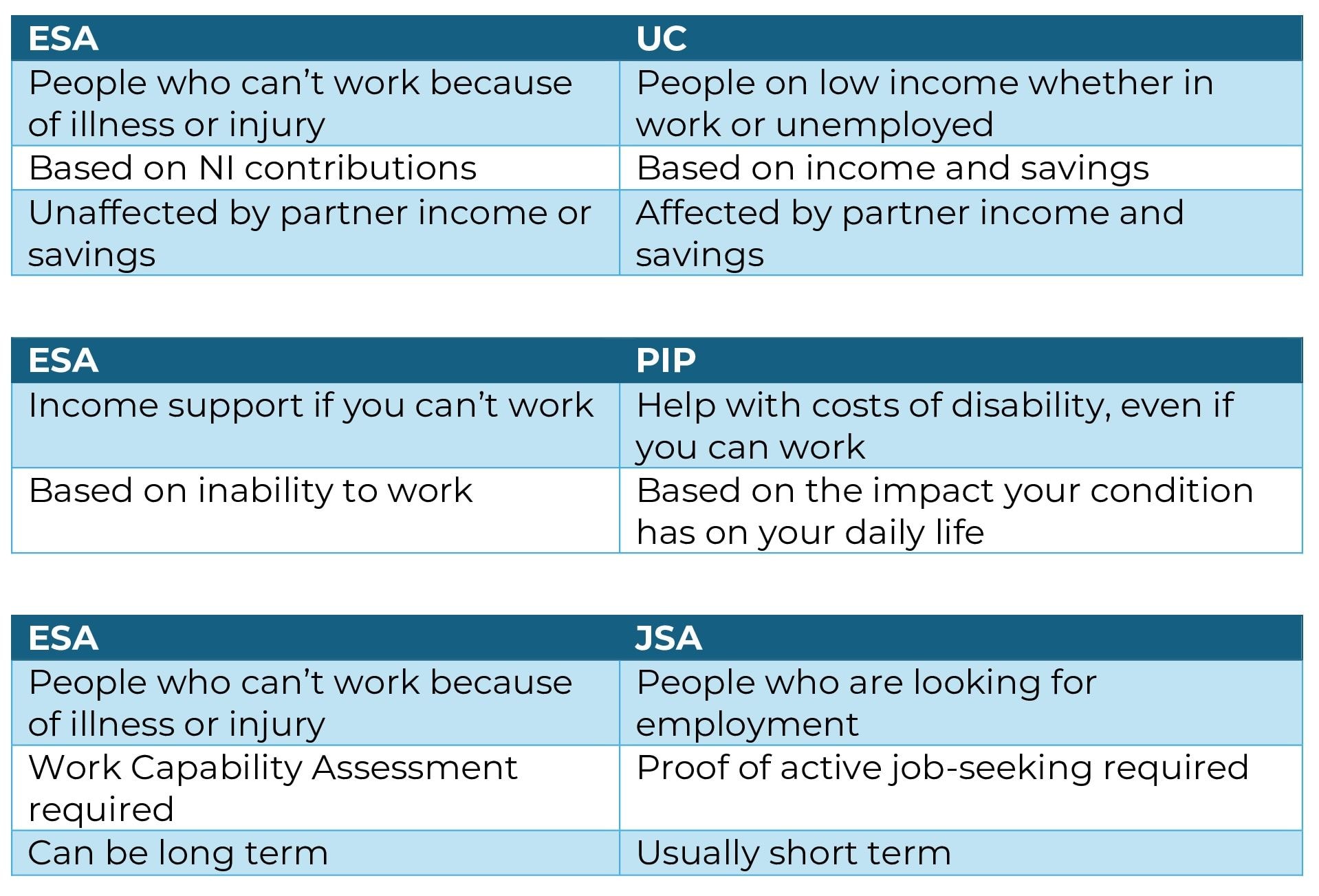
Originally there were two types of ESA, income-based ESA and contribution-based ESA. These have both been withdrawn for new claimants, although people who started receiving them before they were withdrawn are still getting them and there’s no sign of this changing for the time being.
New Style ESA
It may not have the catchiest name, but New Style ESA is now the only form of ESA for which you can claim. To apply you need to have been employed or self-employed and paid National Insurance contributions in the past 2 to 3 years. If the DWP decides you’re eligible, you’ll be put into one of two groups and paid accordingly. As ever, payments are made every fortnight.
Work-related activity group
This is for claimants who can’t work now but can prepare for work in the future. If you’re in this group you’re obliged to attend regular interviews with a DWP work coach and take reasonable steps to get back into work
Support group
This is for claimants who aren’t expected to be able to work in the foreseeable future. There’s no requirement to attend interviews because your condition is too severe for this to have much purpose. However, if you feel you can take part in work-related activities, you’re free to ask.
You can apply for New Style ESA if:
- You’re below the state pension age (currently 66 but set to rise in the next few years)
- You have a physical or mental health condition that stops you from working or limits how much you can work
- You’ve previously been employed or self-employed
- You’ve paid enough in National Insurance contributions (or have NI credits) for the past 2 tax years. That means either 2 years of full contributions or 1 year of full contributions and 1 year of NI credits.
In addition claimants are likely to have to undergo a work capability assessment and in some cases a separate medical assessment. Your claim usually takes 13 weeks to be assessed.
The rates for 2025-2026 are:
- Up to £72.90 per week aged under 25
- Up to £92.05 per week aged 25 and over
It’s possible to get Universal Credit in addition to or in place of ESA, if you fulfil the separate eligibility requirements.
Although it’s possible to apply by phone in exceptional circumstances, applications are made online. This is what you’ll need to submit your claim:
- Your National Insurance number (you’ll find it on letters from the DWP, your P60, in your personal tax account, or you can use the text or chat line to request notification by post)
- Your bank account number and branch sort code
- Your GP’s name, address and phone number
- A fit note confirming you’ve been unable to work for more than 7 days in a row
- Proof of your income
- The date your SSP ends, if you’re receiving it
tatutory Sick Pay is currently just £118.75 per week. When it ends you can replace it with ESA, but even at the highest rate this won’t go far. That’s why it’s important to consider the alternatives.
Income protection insurance
For anyone who works for a living, whether they’re employed or self-employed, income protection (IP) insurance can give real financial security. The idea is simple and extremely effective: you take out an insurance policy while you’re fit and in work, then, if you get ill or injured and have to stop working, you can make a claim and receive monthly tax-free payments to replace a portion of your lost income.
With an Eleos income protection policy you can receive up to 65% of your normal gross income. Since standard rate tax and NI contributions add up to about 28% of what you earn, the maximum IP payment is only a slightly less than what you would normally take home. Unlike ESA, you can claim it even while you’re getting SSP (although the combined payments won’t exceed you’re insurance amount).
You can choose a maximum benefit payment period of 1 or 2 years for each claim and you can claim as often as you need to as long as you keep your policy active.
Other state benefits
Universal Credit is the new single-payment system that’s gradually replacing all other state benefits and you may be able to claim this in addition to ESA. Depending on your circumstances and the level of cover you have, you may also be able to combine UC with income protection.
Savings
Many people build up their savings, either to pay for a major purchase or simply to give themselves an emergency fund. It’s always a wise thing to do, but if you lose your income for weeks or even months, do you really want to take a chunk out of those savings just to pay the bills? You can only spend your savings once, whereas income protection insurance can support you any time you have to stop working.

Not happy with what ESA offers?
Then maybe it's time you thought about income protection insurance
What is Employment and Support Allowance?
Frequently asked questions
Fact-checked and reviewed by Kiruba Shankar Eswaran or another licensed agent on our team. Read our editorial standards.
This guide is for general educational purposes and is not financial advice. Cover, eligibility and terms vary by insurer and by policy. Always read the policy documents for the full terms, limitations and exclusions before you buy.
Related resources
Life insurance cost UK 2026: what 6,557 real insurer quotes show
We collected 6,557 live quotes from UK life insurers in September 2026 and compared every one. Median prices by age, cover amount and policy length, how much smoking multiplies your premium, why bigger policies cost less per pound, and how mortgage protection compares with level cover.

What Is Term Life Insurance? UK Guide & Quotes (2026)
A complete UK guide to term life insurance: how it works, what it costs, the main policy types, underwriting, how it compares with whole of life, and the top UK providers.

6 Financial Resilience Tips for 2026
New Year, new money mindset. It’s time to break free from financial anxiety once and for all. Here are six simple tips to boost your financial resilience in 2026 and bring you peace of mind all year long!

Life Insurance for Young Adults
Life insurance for young adults doesn't have to be complicated or costly. This comprehensive guide covers why purchasing life insurance as a young adult locks in lower rates based on current health and how to pick the proper policy length and provider for your situation.

Turning Customer Curiosity Into Confidence: Theea's Coverage Calculator
Introducing Theea's Coverage Calculator: the intuitive insurance tool inspired by thousands of customer conversations that turns anxiety into tailored advice and confusion into confident choices.

Meet Your Newest Eleos Perks
We’re expanding our perks with two new additions designed to turn good intentions into healthy habits. Discover everything you can get for free with an Eleos policy.